Belkyra Kybella (Deoxycholic Acid) Fat Dissolver
Belkyra / Kybella
Prescription medicineInjectable deoxycholic acid treatment for submental fat reduction
Certifications
- Authorised as a prescription Only medicinal product for submental fat reduction by multiple national regulatory agencies, including the MHRA (UK), EMA Coordinated national authorisations in numerous EEA countries, FDA (USA, as Kybella) and other regulators such as Health Canada and TGA Australia.
- Manufactured in compliance with Good Manufacturing Practice (GMP) standards for sterile injectable medicines.
- Developed and approved on the basis of phase 2 and 3 clinical trials demonstrating efficacy and safety for the approved indication in adults.
- Subject to ongoing pharmacovigilance and risk management plans in the EU, UK, Canada, Australia and other markets.
- Authorised as a prescription Only medicinal product for submental fat reduction by multiple national regulatory agencies, including the MHRA (UK), EMA Coordinated national authorisations in numerous EEA countries, FDA (USA, as Kybella) and other regulators such as Health Canada and TGA Australia.
- Manufactured in compliance with Good Manufacturing Practice (GMP) standards for sterile injectable medicines.
- Developed and approved on the basis of phase 2 and 3 clinical trials demonstrating efficacy and safety for the approved indication in adults.
- Subject to ongoing pharmacovigilance and risk management plans in the EU, UK, Canada, Australia and other markets.
Injectable deoxycholic acid treatment for submental fat reduction
Description
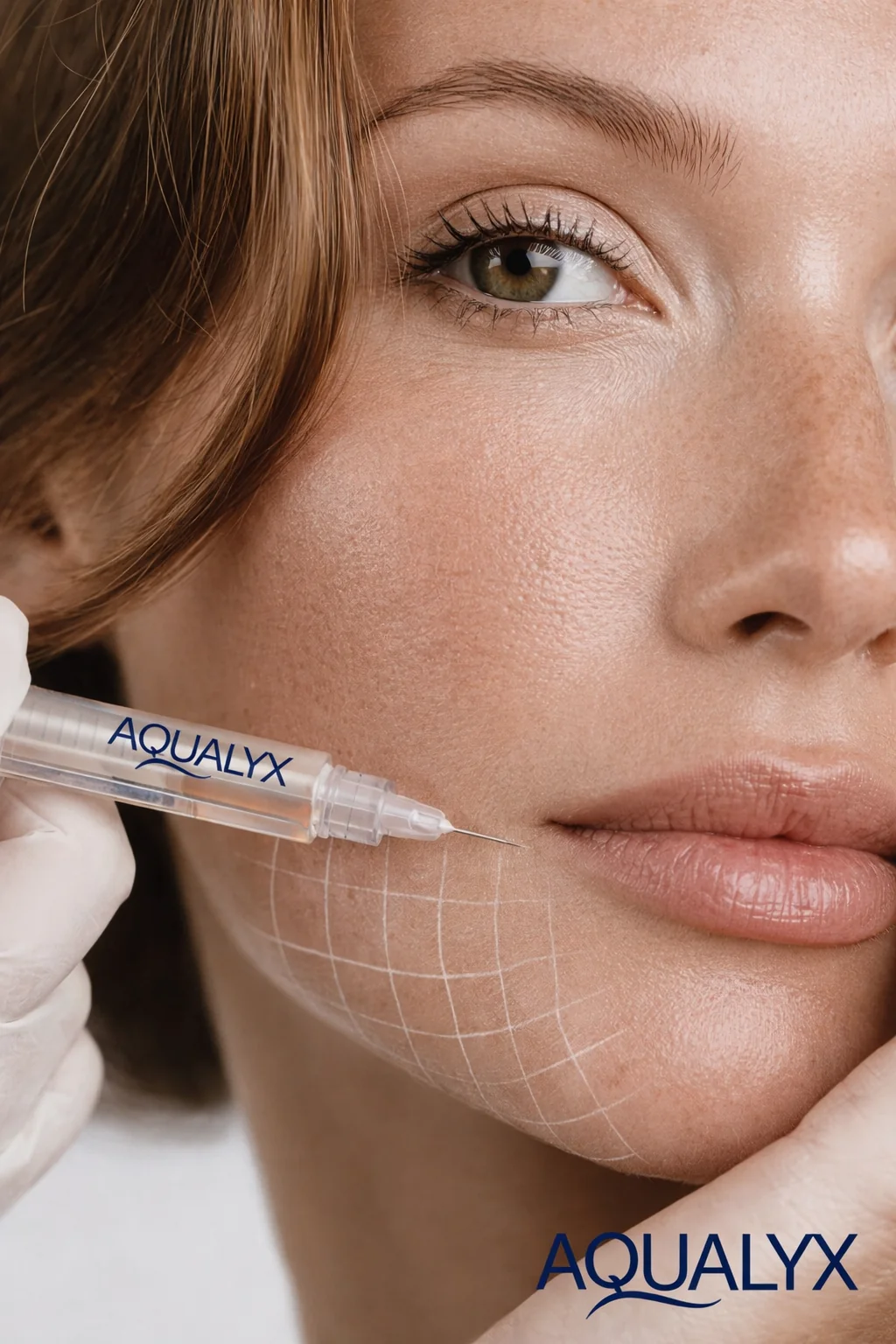
Belkyra (marketed as Kybella in some regions) is a prescription, non-surgical injectable treatment that contains deoxycholic acid 10 mg/mL, a cytolytic bile acid used to reduce moderate to severe submental fat (double chin) in adults. The clear, colourless sterile solution is injected into the subcutaneous fat under the chin by a trained healthcare professional, where it destroys fat cell membranes. Over time, the treated fat cells are cleared through normal metabolic pathways, leading to a slimmer, more contoured jawline and neck profile. Once the fat cells are destroyed, they cannot store or accumulate fat again, so retreatment is not usually required after a full treatment course has been completed.
Bnefits
- Non-surgical option for reducing moderate to severe submental fat (double chin) without liposuction or incisions.
- Contains deoxycholic acid, a synthetic version of a naturally occurring bile acid that destroys fat cells at the injection site.
- Provides gradual but long-lasting improvement in chin and jawline contour once the full treatment course is completed.
- Targets localised fat under the chin, allowing contouring of the submental area while leaving surrounding tissues largely unaffected when properly injected.
- Can improve the appearance of fullness under the chin that persists despite diet and exercise.
- Office-based procedure that can be performed by appropriately trained medical professionals.
- Extensively studied in multiple phase 3 clinical trials showing significant reduction in submental fat and improved patient-reported satisfaction.
- Regulator-approved in multiple countries (including MHRA, EMA, FDA and others) for submental fat reduction in adults.
Indications
- Improvement in the appearance of moderate to severe convexity or fullness associated with submental fat (double chin) in adults.
- Treatment of unwanted submental fat in adults when its presence has an important aesthetic or psychological impact and the patient desires a less invasive alternative to surgical procedures.
- Use only in the submental (under-chin) area; safety and efficacy for fat reduction in other body areas have not been established and are not recommended.
Composition
- Active ingredient: Deoxycholic acid 10 mg/mL (synthetic, non-human, non-animal-derived).
- Each 2 mL single-use vial contains 20 mg deoxycholic acid.
- Excipients (non-medicinal ingredients): benzyl alcohol (preservative, approximately 18 mg per 2 mL vial, in some presentations), dibasic sodium phosphate, sodium chloride, sodium hydroxide, hydrochloric acid (for pH adjustment), and water for injections.
- The solution is adjusted to approximately pH 8.3 and is isotonic with biological fluids.
- Clear, colourless, sterile solution essentially free of visible particiculates.
Formulation
- Pharmaceutical form: Solution for injection for subcutaneous use.
- Strength: 10 mg/mL deoxycholic acid.
- Presentation: Clear, colourless solution in single-use 2 mL glass vials with chlorobutyl rubber stopper, aluminium seal and polypropylene flip-top lid.
- Each vial: 2 mL of solution containing 20 mg deoxycholic acid.
- Drug class: Cytolytic agent for localised fat reduction.
- Route of administration: Subcutaneous injection into submental fat by a trained healthcare professional.
Packaging
- Supplied as single-use Type I glass vials containing 2 mL of solution (20 mg deoxycholic acid).
- Typical commercial pack: Carton containing 4 single-use 2 mL vials.
- Vials closed with chlorobutyl rubber stoppers, aluminium crimp seals and plastic flip-off caps with product-specific hologram in some markets.
- Outer carton labelled with brand name (Belkyra or Kybella), strength, batch number, expiry date, storage conditions and regulatory information.
Usage
- Belkyra/Kybella is a prescription-only medicine and must only be administered by a suitably qualified and trained healthcare professional familiar with submental anatomy and the official prescribing information.
- The medicine is injected into the subcutaneous fat in the submental (under-chin) area in a series of small injections during in-clinic treatment sessions.
- The total volume and number of injections per session, as well as the number of sessions, are individualised based on the patient’s submental fat distribution, anatomy and treatment goals, and must follow the approved product information.
- Treatment typically consists of multiple sessions spaced several weeks apart, with clinical trial regimens allowing up to six treatments; the exact plan should be determined by the prescribing clinician.
- Before treatment, patients should be assessed for other possible causes of submental fullness (for example, enlarged thyroid, lymph nodes) and for suitability, including medical history and risk factors.
- Only clear, colourless solutions free of visible particles should be used; any vial with discolouration or particulate matter should be discarded according to local regulations.
- Belkyra/Kybella is for submental use only; it must not be injected into or near nerves, salivary glands, major blood vessels, muscles or outside the approved treatment area.
- After use, any remaining solution in a vial must be discarded; vials are single-patient, single-use only and must not be stored or reused.
- Patients must be provided with the patient information leaflet and counselled on expected post-treatment reactions (swelling, bruising, discomfort) and when to seek medical advice.
Contraindications
- Hypersensitivity to deoxycholic acid or to any excipient in the formulation (including benzyl alcohol, where present).
- Presence of infection in the planned treatment area under the chin.
- Known or suspected pregnancy, or breastfeeding, unless the potential benefit clearly outweighs potential risk as judged by a physician (many guidelines advise avoiding cosmetic use in these situations).
- Patients with significant dysphagia (difficulty swallowing) or known bleeding disorders should generally not be treated, or should only be treated with particular caution and specialist judgement.
- Use outside the approved submental area (for example, body contouring elsewhere) is not recommended because safety and efficacy have not been established.
- Patients with prior surgery, scarring or altered anatomy in the submental region should be assessed carefully; treatment may be contraindicated or require modified approach according to the prescriber.
Adverse Effects
- Very common injection-site reactions including pain, swelling, bruising, numbness, erythema (redness), induration (firmness), itching and warmth.
- Temporary nodules, hardness or areas of firmness under the skin at the injection sites.
- Injection-site haematoma (bruising) and oedema (swelling), which may make the area appear more prominent for several days after treatment.
- Numbness or altered sensation in the treatment area, typically resolving over time.
- Injection-site nerve injury, including marginal mandibular nerve paresis, which may cause transient smile asymmetry or weakness of the lower lip in some patients.
- Dysphagia (difficulty swallowing) has been reported in some patients following treatment.
- Ulceration, necrosis or infection at the injection site if the medicine is inadvertently injected into or too close to the skin surface or if aseptic technique is not followed.
- Allergic or hypersensitivity reactions, ranging from local reactions to, rarely, more generalised responses.
- As with any injectable treatment, there is a small risk of serious complications if the product is misplaced into non-target tissues or if individual risk factors are present; patients must be monitored and instructed to seek medical attention for severe or unexpected symptoms.
Storage Conditions
- Store below 30°C (or within the temperature range specified in local product information).
- Do not freeze.
- Store in the original carton to protect from light and to maintain product identification and batch information.
- Keep vials in a dry place and avoid excessive heat or temperature fluctuations.
- Keep out of the sight and reach of children.
- Do not use after the expiry date printed on the vial and outer carton; dispose of expired or unused product according to local pharmaceutical waste regulations.
Duration
Treatment duration varies by patient and is determined by the prescribing healthcare professional. In clinical studies, patients could receive up to six treatment sessions, typically spaced at least several weeks apart, until the desired reduction in submental fat was achieved.
Onset
Some reduction in submental fullness may be visible within weeks after initial treatments, but full results generally appear gradually over the course of the treatment series and subsequent healing period as destroyed fat cells are cleared by the body.