A patient cancels at 9am for a 2pm appointment. Your treatment room will sit empty. Your practitioner is still there, paid for, ready. That slot — which someone else would happily have taken — vanishes into lost revenue.
It is one of the most common and most frustrating revenue leaks in aesthetic clinics. And for most clinics, the response is a staff member picking up the phone and working through a list of names, hoping someone can make it on short notice.
That process is inefficient, inconsistent, and almost always slower than the cancellation window it is trying to fill. A well-managed waiting list — built into your booking system rather than scrawled on a notepad — changes that completely.
Why late cancellations do not have to mean lost revenue
The gap between a cancellation and an empty appointment slot is not inevitable. It is a systems problem. The reason most clinics fail to fill late cancellations is not lack of demand — aesthetic clinics typically have more patients who want appointments than available slots — it is response time and reach.
A patient who cancels at midday for a 3pm appointment leaves roughly three hours to find a replacement. A staff member calling through a written list, between other duties, during a busy clinic day, is unlikely to get to enough people in time. An automated system that instantly messages every relevant patient on the waiting list gets there in seconds.
Industry data shows that automated waitlist systems recover 60–70% of last-minute cancellations. Manual systems cannot consistently achieve this, not because the demand is not there, but because the human response time is too slow.
How manual waiting lists fail (and why clinics keep using them anyway)
BA standalone photo consent document should address the following:
The manual waiting list persists in aesthetic clinics for the same reason paper consent forms did: it works often enough that the failure mode is invisible. A slot gets filled, so it feels like the system is working. What is invisible is the number of slots that did not get filled, or were filled by the third or fourth person on the list after two declined, or were not filled because the receptionist was with a patient when the cancellation came in.
Common manual waiting list problems:
- A single undifferentiated list: patients waiting for Botox, filler, skin peels, and laser all sit in the same queue, so when a Botox slot opens you have to filter manually
- No record of who was contacted: you cannot see if a patient has been offered a slot three times and declined, versus never been contacted
- Dependency on staff availability: if the front desk is managing a patient at the desk, the list does not get worked
- WhatsApp groups: first-come-first-served group messages create a chaotic, unprofessional experience and have no audit trail for GDPR compliance
Bookings, consent forms, patient records, payments, marketing — Consentz is the aesthetic clinic software that puts it all in one place so you can focus on your patients, not paperwork.
How an automated waiting list works
An automated waiting list in purpose-built clinic management software works like this:
- A patient is added to the waiting list — ideally filtered by treatment type and preferred time slots
- When a cancellation occurs, the system identifies which patients on the waiting list match the slot (treatment, practitioner, timeframe)
- An automatic SMS or email notification is sent to all matching patients simultaneously, offering the slot with a link to confirm
- The first patient to confirm gets the appointment booked — the system updates the diary automatically and removes the slot offer from other patients
- You receive a notification that the slot has been filled — no manual action required
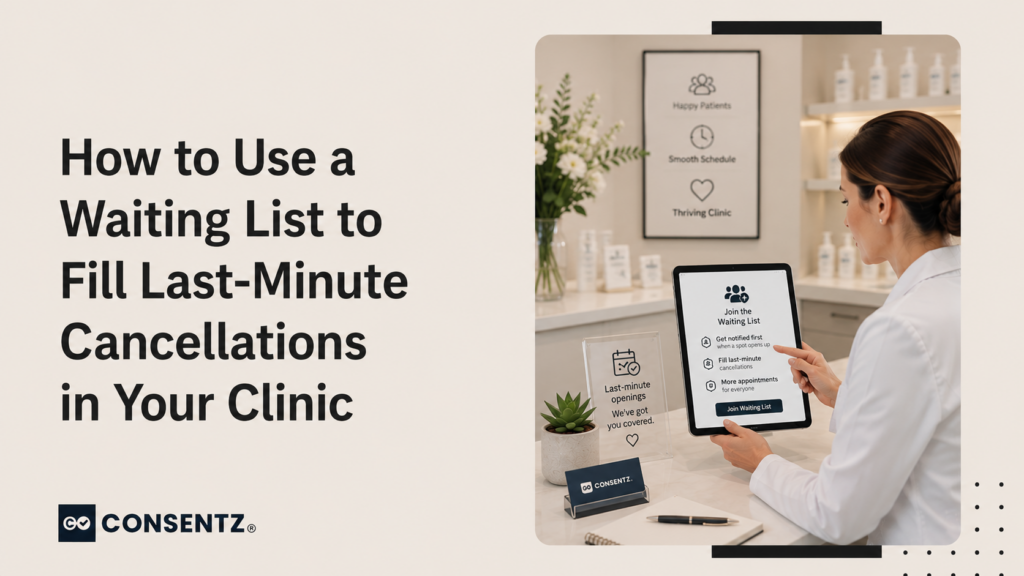
Consentz’s waiting list module works exactly this way. Patients are filtered by treatment type so that a Botox cancellation only notifies patients waiting for Botox — not the whole list. The first to confirm gets the slot. No phone calls, no manual rescheduling, no staff overhead.
Setting up your waiting list so it actually works
Define what ‘lapsed enough’ means for your list
Before you can fill slots from your waiting list, you need patients on it. You need a clear process for adding people — the most natural moments being:
- When a patient calls or emails enquiring about a treatment and no slot is immediately available
- When a patient arrives for a consultation and wants a treatment sooner than the next available appointment
- When a patient asks to be on standby for cancellations for a specific date range
Make adding a patient to the waiting list as quick as adding a booking — it should take fifteen seconds, not a form-filling exercise.
Segment by treatment type, not just availability
A patient waiting for a 90-minute laser resurfacing treatment is not useful to you when a 20-minute Botox slot opens. Keep separate waiting lists — or filter entries by treatment — so that when a slot opens you are notifying the right people.
Set the right expectations with patients on the list
Patients on a waiting list should know: how they will be contacted when a slot opens (SMS, email, or both), that it is first-come-first-served and they need to respond quickly, and roughly how long waits typically are for their treatment. Setting clear expectations upfront avoids frustration and improves your conversion rate from offer to booking.
The waiting list as a marketing tool
Beyond filling cancellations, a well-used waiting list does something else: it creates visible demand. A waiting list for a new treatment signals to patients that it is in demand — and scarcity is one of the most powerful drivers of bookings in aesthetics.
When you launch a new treatment, open a new practitioner’s diary, or run a limited seasonal availability campaign, building a waiting list first — and then releasing slots to waiting list patients before general booking opens — creates momentum, drives word-of-mouth, and converts a higher proportion of enquiries to bookings than opening general availability straight away.
See our post on using your waiting list as a marketing tool for the full approach.
Frequently asked questions
1. How do I manage a waiting list without it becoming a mess?
The single most important thing is to keep it inside your booking system rather than in a separate spreadsheet, notepad, or WhatsApp group. When the waiting list is in your clinic software, it is filtered by treatment type, automatically updated when patients are offered and accept or decline slots, and has a complete audit trail for GDPR purposes. Out-of-system lists are unmanageable at any real volume.
2. Can software automatically notify waiting list patients when a slot opens?
Yes — this is exactly what Consentz’s waiting list module does. When a cancellation occurs, matching patients are notified by SMS and/or email simultaneously. The first to confirm gets the slot, the diary updates automatically, and the notification is withdrawn from the remaining patients. No staff member needs to be involved unless there is a query.
3. Should I have one waiting list or separate ones per treatment?
Separate by treatment type at minimum. A general waiting list creates more work than it saves because you have to manually filter it every time a slot opens. Treatment-specific lists mean the automation can match slots to the right patients instantly. If you offer very distinct appointment lengths (e.g. a quick 15-minute review versus a 90-minute laser session), consider filtering by both treatment type and approximate appointment duration.
4. How do I make sure the right patient gets offered the right slot?
Collect enough information when adding patients to the list: which specific treatment they want, which practitioner (if they have a preference), and what days and times work for them. The more specific the filter, the better the match when a slot opens — and the better the conversion rate from offer to confirmed booking.
5. Is a digital waiting list better than a WhatsApp group?
Significantly. A WhatsApp group creates a first-come-first-served scramble, has no treatment filtering, gives no audit trail for GDPR, and is entirely manual. A digital waiting list in your booking system is automatic, filtered, compliant, and fast. It also does not put you in a situation where multiple patients think they have confirmed the same slot.