Polynucleotide and hyaluronic acid skinbooster for mature, dehydrated skin and scars
Certifications
CE Marked Class III medical device (CE0373) for intradermal use in aesthetic medicine
Manufactured in the European Union following PN HPT® high purification technology with documented quality and safety standards
Distributed by Croma Pharma GmbH under certified medical device quality management systems (including ISO 13485) in applicable territories
Intended for use only by appropriately qualified healthcare professionals in accordance with EU Medical Device Regulation (MDR) and relevant local regulations
Supported by published clinical and consensus data on PN HPT® polynucleotides for aesthetic indications including skin rejuvenation and scar remodelling
CE Marked Class III medical device (CE0373) for intradermal use in aesthetic medicine
Manufactured in the European Union following PN HPT® high purification technology with documented quality and safety standards
Distributed by Croma Pharma GmbH under certified medical device quality management systems (including ISO 13485) in applicable territories
Intended for use only by appropriately qualified healthcare professionals in accordance with EU Medical Device Regulation (MDR) and relevant local regulations
Supported by published clinical and consensus data on PN HPT® polynucleotides for aesthetic indications including skin rejuvenation and scar remodelling
Polynucleotide and hyaluronic acid skinbooster for mature, dehydrated skin and scars
Description
POLYPHIL NEXT (PHILART) (1x2ml) is an injectable biostimulating skin booster from the Croma PolyPhil/PhilArt polynucleotide range. It combines PN-HPT® (Polynucleotides Highly Purified Technology) 20 mg/2 ml with non-crosslinked hyaluronic acid 20 mg/2 ml (plus mannitol as an antioxidant excipient) in a sterile gel designed for intradermal injection. The product is indicated for mature and dehydrated skin and for the remodelling of depressed scars and acne scars, particularly on the face (including the middle third), neck and hands. By providing both deep hydration and biostimulation of fibroblasts, it helps improve skin elasticity, firmness, tone and texture, and is approved as a Class III medical device for strict professional use.
Bnefits
Deeply rehydrates mature and dehydrated skin thanks to the combination of polynucleotides and non-crosslinked hyaluronic acid (20 mg/2 ml each)
Stimulates fibroblasts and promotes collagen and elastin production, improving skin elasticity, firmness and overall quality
Helps correct medium to deep wrinkles, fine lines and visible signs of fatigue in mature skin
Improves the appearance of depressed scars and acne scars through dermal remodelling effects
Enhances skin tone, radiance and texture, leading to a more uniform and revitalised complexion
Creates an optimal environment for cell regeneration and tissue repair via PN-HPT® long-chain polynucleotides
Acts as a Skin Enhancement Technique (SET) and priming treatment, improving outcomes of subsequent procedures such as laser, radiofrequency, fillers, peels, needling and surgery
Can be used on several anatomical areas (face including middle third and tear trough region, neck and hands) in a wide range of mature skin patients
High biocompatibility profile and CE-marked Class III medical device status with safety supported by multiple clinical and consensus publications on PN-HPT®
Indications
Mature and dehydrated skin of the face, particularly the middle third
Mature and dehydrated skin of the neck
Mature and dehydrated skin of the hands
Improvement of skin quality (elasticity, trophism, firmness, tone and appearance) in ageing skin
Correction of medium to deep wrinkles and visible signs of fatigue in mature skin
Remodelling of striae distensae (stretch marks) as part of personalised treatment protocols
Remodelling of depressed scars, including acne scars
Skin priming / Skin Enhancement Technique (SET) before other aesthetic procedures (e.g. laser, RF, fillers, peels, microneedling, surgery) to optimise outcomes
Composition
PN-HPT® long-chain polynucleotides 20 mg/2 ml
Non-crosslinked hyaluronic acid 20 mg/2 ml
Mannitol (quantity not specified in public fact sheet), added to slow down hyaluronic acid degradation
Buffered injectable vehicle solution suitable for intradermal administration (full excipient list provided in the official Instructions for Use)
Concentration per pre-filled syringe: PN-HPT® 20 mg/2 ml and hyaluronic acid 20 mg/2 ml
Contains mannitol as an antioxidant excipient to help protect hyaluronic acid from degradation
Non-crosslinked formulation designed for biostimulation and hydration rather than volumising filler effect
Single-use, pyrogen-free Class III medical device intended for intradermal injection by healthcare professionals only
Packaging
Pack: 1 x 2 ml pre-filled syringe of POLYPHIL / PhilArt Next
Needles supplied: 2 x 30G 1/2, length 13 mm, disposable sterile needles
Sterile blister packaging with outer carton and technical fact sheet / Instructions for Use
Labelled as a medical device (Class III), professional-use only
Often referenced under customs/tariff code 30049000 in distributor listings
Usage
For intradermal injection only and strictly for use by appropriately trained and authorised healthcare professionals experienced in aesthetic injectable procedures.
Anatomical areas listed in the official technical fact sheet include face (including tear trough deformities), neck and hands; distributor and clinic materials also highlight use on the face’s middle third and for scars and acne scars.
Depth of injection: intradermal (dermis), as specified in the technical fact sheet.
Recommended treatment volume: 2 ml per session (one full syringe).
Treatment protocol from PhilArt Next technical fact sheet: one session every 14 or 21 days for a total of 3 sessions for normal ageing skin and 4 sessions for more advanced ageing skin.
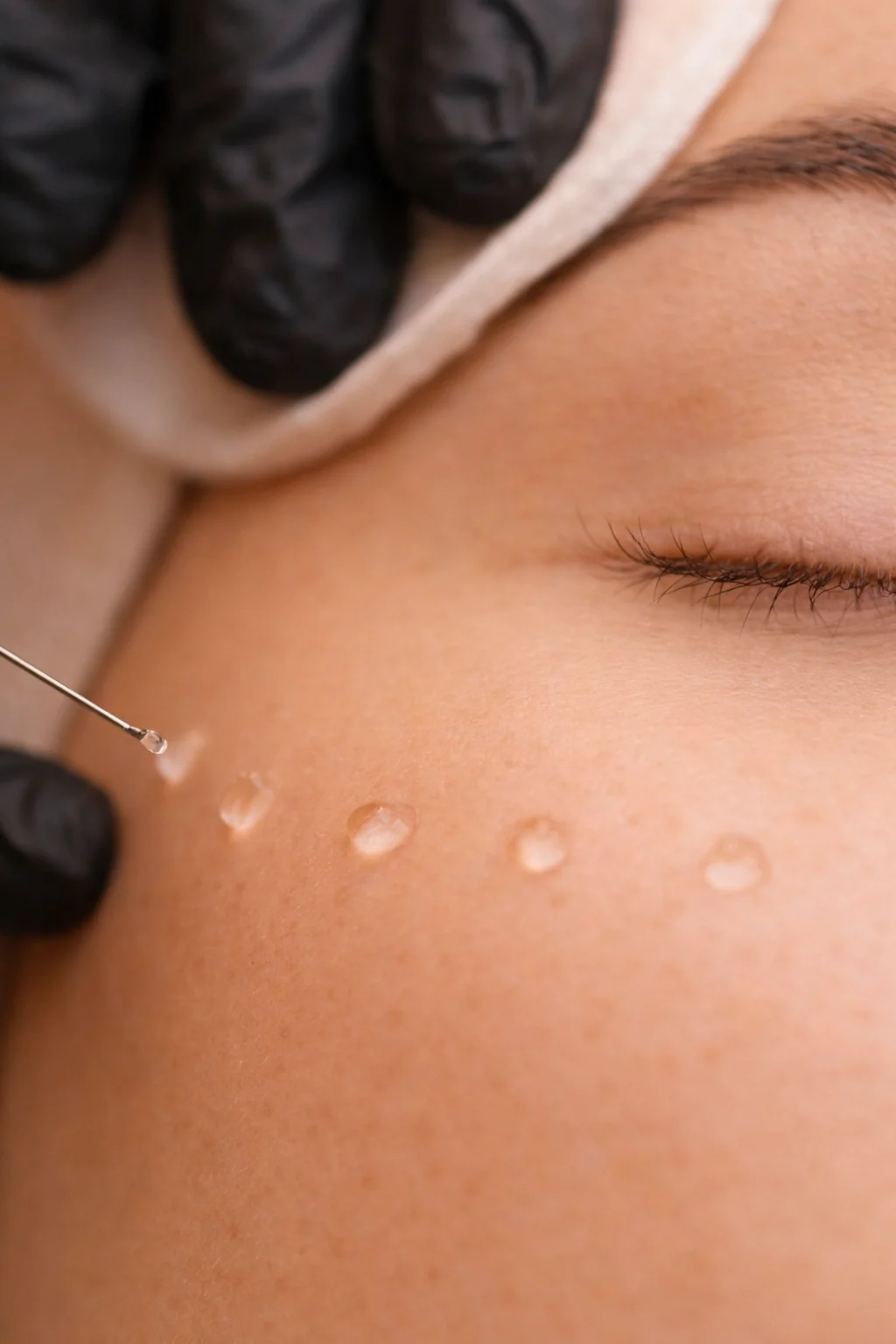
Recommended injection techniques: needle microdroplet (multipoint) or linear retrograde threading; other linear or fan techniques can be used within the dermis, according to practitioner training and patient needs.
PhilArt Next can be used as a standalone therapy to significantly improve hydration and foster fibroblast activity, restoring or improving skin elasticity, trophism, firmness, tone and appearance.
It is also indicated in the technical documentation as a Skin Enhancement Technique (SET) to generate a synergistic effect and to prepare the skin before other aesthetic procedures such as laser, radiofrequency, fillers, peels, needling and surgery.
Standard aseptic technique must be observed: check integrity of the blister and syringe, verify expiry date and appearance of the gel (no particulate matter, no discoloration) before use; discard any damaged or compromised units.
Post-treatment, patients are typically advised to avoid makeup on the treated area for a short period, refrain from intense heat/cold exposure (sauna, solarium), and avoid vigorous rubbing or massage of the treated areas, following the clinic’s protocol and IFU guidance.
Contraindications
Known hypersensitivity or allergy to polynucleotides (PN-HPT®), hyaluronic acid, mannitol or any other component of the product
Active skin infection, inflammation, dermatitis, psoriasis or other lesions at or near the intended injection sites
History of severe allergic reactions or anaphylaxis to injectable implants or similar biostimulating or HA-based products, where the practitioner judges treatment unsafe
Autoimmune diseases, immunodeficiency or other systemic conditions in which stimulation of tissue repair may be contraindicated unless carefully assessed and cleared by a specialist
Pregnancy and breastfeeding (use generally not recommended because of insufficient safety data in these populations)
Uncontrolled coagulation disorders or concurrent anticoagulant/antiplatelet therapy where there is an unacceptable risk of bleeding or significant bruising at injection sites
Severe systemic illness or poorly controlled chronic disease where elective aesthetic injectable treatments are inappropriate in the judgement of the treating physician
Previous serious adverse reaction to polynucleotide-based injectables or PhilArt/PolyPhil range products, if considered relevant by the practitioner
Adverse Effects
Typical, usually transient injection-site reactions such as erythema (redness), mild to moderate swelling or oedema, tenderness, pain, itching and small bruises or ecchymoses
Temporary papules, small nodules or surface irregularities at the intradermal injection points, usually resolving spontaneously within a few days
Localized haematoma, increased sensitivity or transient discomfort in the treated area, particularly in thin or delicate skin regions
As with all injectable medical devices, there is a low but present risk of infection if aseptic technique is not strictly followed; signs can include increasing redness, warmth, pain, pus or fever
Potential for hypersensitivity or inflammatory reactions; in rare cases, more intense inflammatory nodules or granulomatous reactions may occur
Very rare but serious complications associated with dermal injections in general include vascular compromise or inadvertent intravascular injection, which may result in tissue ischaemia; practitioners must be trained in recognition and management of complications
Patients should be advised to contact their practitioner promptly if they experience persistent or worsening pain, significant or asymmetrical swelling, visual disturbances, signs of infection or any unexpected or severe symptoms after treatment
Storage Conditions
Store in a clean, dry place at controlled room temperature, typically between 2°C and 25°C, as per common storage recommendations for PhilArt/PolyPhil injectable medical devices and IFU guidance.
Keep the pre-filled syringe in its original blister and outer carton to maintain sterility and to protect from light until immediately before use.
Do not freeze the product and avoid exposure to excessive heat or direct sunlight.
Do not use the product after the expiry date printed on the packaging or if the packaging is damaged or previously opened.
Inspect the gel visually before use; do not inject if the solution appears cloudy, discoloured or contains visible particles.
Keep out of the reach of children and non-medical personnel.
Duration
According to the PhilArt Next technical fact sheet and professional-use guidance, a typical initial course consists of 3 sessions (for normal ageing skin) or 4 sessions (for more advanced ageing) performed with 2 ml per session, spaced every 14 or 21 days. This corresponds to an initial treatment duration of approximately 6\u201312 weeks. Additional or maintenance treatments may be scheduled at the practitioner\u2019s discretion based on clinical response, often every several months or annually to sustain skin quality improvements.
Onset
Manufacturer and distributor descriptions report that improvement in skin hydration, texture and overall appearance can be visible after the first treatment, with more pronounced results after completion of the full course of 3\u20134 sessions over several weeks. Benefits in firmness, elasticity, wrinkle reduction and scar remodelling continue to build progressively as fibroblast activity and collagen/elastin synthesis are stimulated over the treatment cycle.