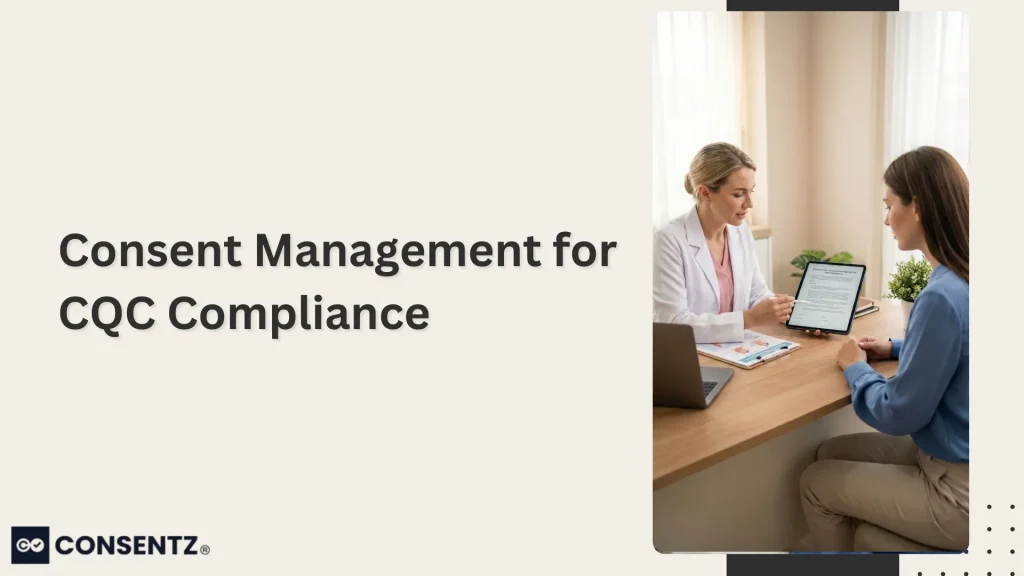
In aesthetic medicine, consent is far more than a signature on a form. It’s the legal and ethical foundation of your practice, and for CQC-regulated clinics, consent management for CQC compliance is one of the most heavily scrutinized areas during inspections. Poor consent processes are the leading cause of CQC requirement notices, downgraded ratings, and enforcement action against aesthetic clinics.
Understanding and implementing robust consent management for CQC compliance protects your patients, strengthens your legal position, and demonstrates the professionalism that builds lasting patient relationships.
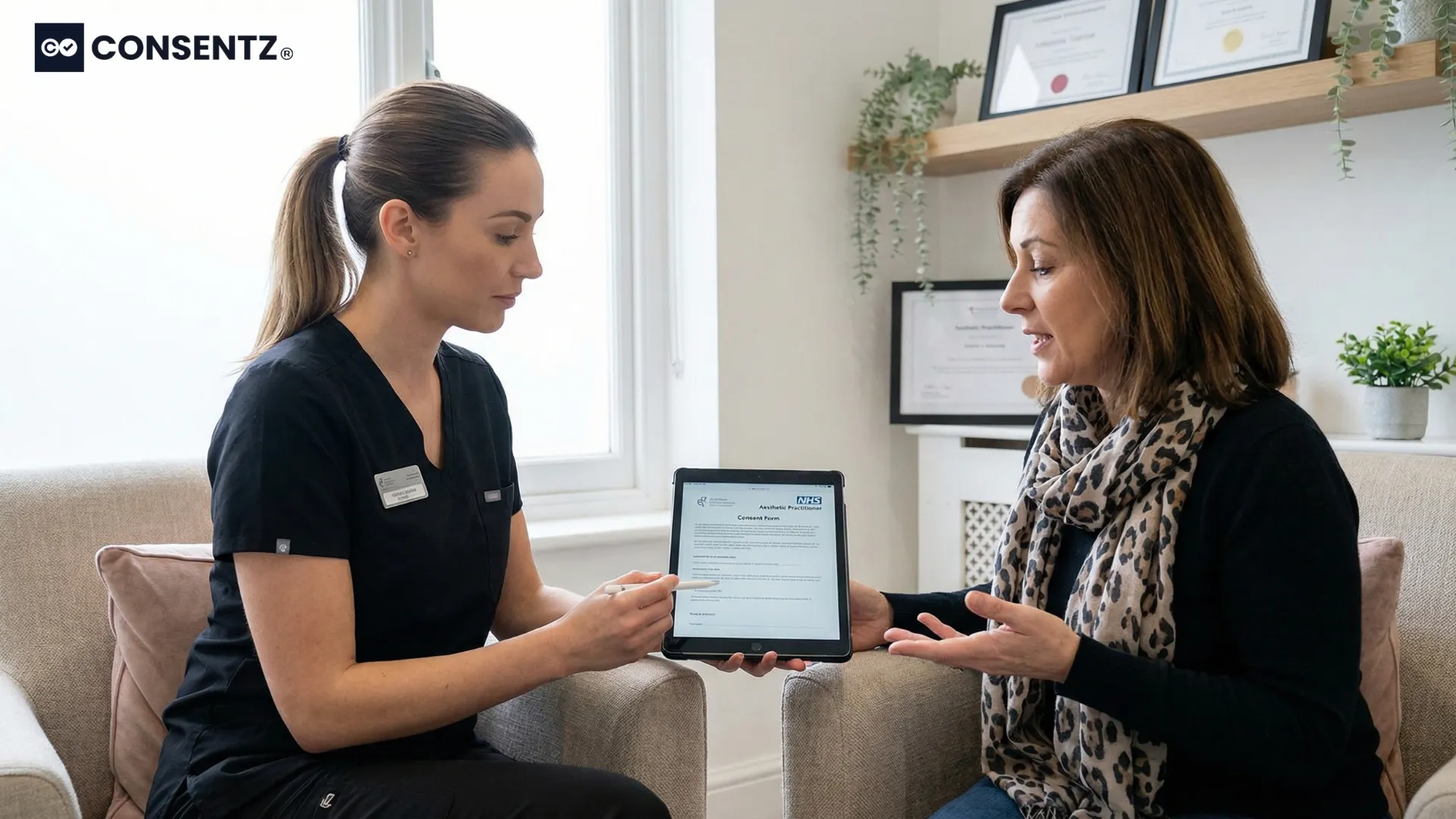
Why Consent Management is Critical for CQC Compliance
Consent isn’t isolated to a single regulation. It threads through all five CQC key domains, making it fundamental to achieving and maintaining a ‘Good’ or ‘Outstanding’ rating:
Safe: Informed consent ensures patients understand treatment risks, reducing complications from unrealistic expectations or undisclosed medical conditions. When patients know what to expect, they’re less likely to panic over normal post-treatment effects and more likely to follow aftercare instructions that prevent complications.
Effective: Thorough consent processes set realistic expectations, directly improving patient satisfaction. The disconnect between patient expectations and actual outcomes is the primary driver of complaints in aesthetic medicine. Proper consent bridges this gap.
Caring: Taking time to explain treatments, answer questions, and respect patient autonomy demonstrates genuine care. The consent conversation is where patients feel heard and valued, not just processed.
Responsive: Flexible consent processes accommodate individual needs, whether that’s providing information in different formats, allowing extra time for questions, or addressing specific patient concerns about their unique circumstances.
Well-led: Robust consent systems demonstrate clinical governance, ethical practice, and professional leadership. The quality of your consent process signals the overall quality of your clinic to CQC inspectors.
What Makes Consent Valid Under CQC Requirements
The CQC applies strict criteria for valid consent based on the Montgomery ruling and Regulation 11. Consent must be:
Voluntary: The patient makes the decision independently without pressure from practitioners, family, partners, or financial incentives. This is particularly important in aesthetic medicine, where patients may face external pressure to undergo treatments. Red flags include partners answering for patients, rushed decision-making, or patients who seem uncertain but proceed anyway.
Informed: The patient receives comprehensive information covering what the treatment involves, realistic expected outcomes and limitations, all material risks (not just risks you consider significant), alternative treatment options including doing nothing, what happens if they decline treatment, and costs, including any additional procedures that might be needed. Following the Montgomery ruling, you must discuss risks that a reasonable person would want to know, regardless of statistical probability.
Capacious: The patient understands the information provided and can weigh it to make a decision. Capacity assessment is particularly important for patients with mental health conditions, those under the influence of alcohol or drugs, or anyone who seems confused or unable to retain information. Assume capacity unless you have specific reasons to doubt it, but document your assessment.
Continuing: Consent isn’t a one-time event. It must be reconfirmed if circumstances change, treatment plans are modified, or significant time passes between consent and treatment. For multi-session treatments, review consent at each appointment.
Common Consent Failures in Aesthetic Clinics
Understanding where clinics typically fail helps you avoid the same mistakes:
Generic Consent Forms
Using the same basic consent form for Botox, dermal fillers, thread lifts, and chemical peels fails CQC requirements. Each treatment has unique risks that must be explicitly addressed. A generic form suggesting you’ve properly informed patients about treatment-specific complications is immediately flagged during inspections.
No Cooling-Off Period
Performing cosmetic procedures on the same day as the initial consultation violates CQC guidance. Patients need time to consider information without the pressure of a practitioner waiting to proceed. Minimum cooling-off periods are typically 24-48 hours, though complex procedures may warrant longer reflection time.
Insufficient Risk Discussion
Listing every possible risk on a form but not actually discussing them verbally fails informed consent requirements. Patients must have the opportunity to ask questions and understand risks in plain language, not just sign acknowledgment that they received written information.
Poor Documentation
Recording “consent obtained” in notes without documenting what was discussed, what questions the patient asked, what specific risks were explained, or how you assessed capacity leaves you vulnerable in complaints or legal challenges. The consent conversation must be comprehensively documented.
Ignoring Capacity Issues
Proceeding with treatment when patients seem confused, uncertain, or unable to articulate why they want the treatment creates serious risk. Signs of capacity concerns include inability to explain what the treatment involves, unrealistic expectations despite explanation, or being unable to weigh risks versus benefits.
Inadequate Follow-Up Consent
For multi-session treatments, obtaining consent once at the start and never reviewing it fails continuing consent requirements. Patients may change their minds, develop concerns, or need information refreshed as treatment progresses.
Essential Elements of Robust Consent Management
Implementing consent management for CQC compliance that withstands inspection scrutiny requires systematic processes:
Treatment-Specific Information Provision
Create detailed information sheets for each treatment covering:
- How the treatment works (mechanism of action in plain language)
- What happens during the procedure (step-by-step description)
- What patients will feel (pain levels, sensations, immediate effects)
- Expected results (realistic outcomes with timeframes)
- Limitations (what the treatment cannot achieve)
- Material risks with approximate frequency
- Alternative treatments with pros and cons of each
- Post-treatment expectations (downtime, restrictions, aftercare)
- Costs including potential additional treatments
Provide these before the consultation so patients arrive informed and ready to ask specific questions rather than absorbing information for the first time under pressure to make decisions.
Two-Stage Consent Process
For cosmetic procedures, implement mandatory two-stage consent:
Stage 1 – Initial Consultation: Assess suitability, discuss treatment options, explain procedures and risks, provide written information, answer questions, and schedule treatment for minimum 24-48 hours later.
Stage 2 – Treatment Appointment: Review information provided, answer any new questions, confirm patient’s decision is voluntary and informed, reconfirm consent verbally and in writing, document this second consent discussion.
This process demonstrates you’re not pressuring patients into immediate decisions and gives them proper reflection time.
Comprehensive Documentation Standards
Your consent documentation must include:
- Date and time of consent discussion
- Who provided the information (practitioner name)
- Specific risks discussed (list the actual risks you talked about)
- Alternatives explained (document what options you covered)
- Questions the patient asked and your responses
- Assessment of capacity (brief note confirming patient understood)
- Cooling-off period confirmation (date of consultation vs. treatment date)
- Patient’s decision and signature
- Practitioner’s signature confirming discussion occurred
This level of documentation protects you legally and demonstrates thoroughness to CQC inspectors.
Capacity Assessment Framework
Develop a simple capacity assessment protocol:
- Can the patient understand information about the treatment?
- Can they retain that information long enough to make a decision?
- Can they weigh the information (consider risks and benefits)?
- Can they communicate their decision?
If you have any concerns, document them and consider postponing treatment. Never proceed if capacity is doubtful.
Visual Aids and Interactive Tools
Enhance patient understanding with:
- Before/after photos showing realistic outcomes
- Anatomical diagrams explaining treatment areas
- Videos demonstrating procedures
- Interactive tools showing potential results
- Written materials in simple language
- Translation services for non-English speakers
The easier you make information to understand, the more genuinely informed consent becomes.
The Montgomery Ruling and Aesthetic Medicine
The landmark Montgomery v Lanarkshire Health Board case (2015) fundamentally changed consent requirements in UK healthcare. The ruling established that clinicians must discuss all risks that a reasonable person would consider material to their decision, not just risks the clinician considers significant.
Implications for aesthetic clinics: You can’t decide which risks to mention based on your clinical judgment alone. If a complication could significantly impact the patient’s life or decision-making, you must discuss it regardless of how unlikely you think it is.
Practical example: Even if vascular occlusion from dermal filler occurs in less than 1 in 1,000 cases, it’s a material risk because it can cause blindness or tissue necrosis. You must discuss it. The statistical rarity doesn’t eliminate the disclosure obligation.
Safe approach: When in doubt, disclose. Over-informing is far safer legally and ethically than under-informing, and patients appreciate thorough information even if they ultimately proceed with treatment.
Digital Consent Management Benefits
Moving from paper-based to digital consent management for CQC compliance provides significant advantages:
Consistency: Digital systems ensure every patient receives the same comprehensive information for each treatment type. You eliminate the risk of forgotten discussions or incomplete forms through systematic prompts.
Accessibility: Patients access information at home before appointments, review it at their own pace, and return with informed questions. This creates genuinely informed consent rather than information overload during consultations.
Audit Trails: Complete records of when information was provided, when patients accessed it, when consent was obtained, and what was discussed. This documentation is invaluable during CQC inspections and complaint investigations.
Version Control: Track updates to consent forms, ensure all practitioners use current versions, and demonstrate continuous improvement of consent processes as guidance evolves.
Integration: Link consent to patient records, treatment notes, and outcome tracking. This creates a comprehensive view of each patient journey.
Efficiency: Pre-populate patient information, automatically include relevant risks for specific treatments, and streamline the administrative burden of consent management.
Frequently Asked Questions About Consent Management for CQC Compliance
How long should the cooling-off period be for cosmetic treatments?
The CQC recommends minimum 24-48 hours between initial consultation and cosmetic treatment, though no specific timeframe is mandated. More complex or invasive procedures warrant longer reflection periods. Best practice is 48 hours minimum for all cosmetic procedures, with 7-14 days for surgical treatments. Document the cooling-off period clearly in your records.
Do I need written consent for every treatment, or is verbal consent acceptable?
While verbal consent is legally valid for minor treatments, written consent is best practice for all aesthetic procedures and is expected by CQC inspectors. Written consent provides evidence that the consent conversation occurred, documents what was discussed, and protects both patient and practitioner. Always obtain written consent for invasive or higher-risk treatments.
What should I do if a patient seems to lack the capacity to consent?
If you suspect a patient lacks capacity, postpone the treatment and document your concerns. Assess using the four-stage capacity test (understand, retain, weigh, communicate). Consider if capacity might be temporary (alcohol, stress, medication) and can be reassessed later. Never proceed with treatment if capacity is in doubt. Consult with colleagues or seek specialist advice if needed.
Can I use electronic signatures for consent forms?
Yes, electronic signatures are legally valid for consent forms if your system ensures authenticity, prevents tampering, and maintains secure records. The person signing must intend it to be their signature, and you must be able to demonstrate the signature came from them. Many digital consent platforms include verification features that exceed paper form security.
How Consentz Transforms Consent Management
The Consentz platform provides comprehensive consent management for CQC compliance specifically designed for aesthetic clinics:
Treatment-Specific Consent Library: Access 40+ pre-built consent forms covering all major aesthetic treatments (Botox, dermal fillers, thread lifts, chemical peels, laser treatments, PDO threads, PRP, mesotherapy, and more). Each form includes treatment-specific risks, realistic outcome expectations, and CQC-compliant documentation standards.
Interactive Patient Information: Provide patients with engaging educational content including procedure videos, before/after galleries, animated explanations of how treatments work, and downloadable information sheets. Patients arrive at consultations genuinely informed rather than overwhelmed.
Automated Cooling-Off Enforcement: The system prevents treatment booking within your specified cooling-off period, ensuring compliance with CQC guidance. Set minimum timeframes for different treatment types and let the system enforce them automatically.
Comprehensive Documentation: Every consent interaction is logged with timestamps, patient access records, questions asked, information provided, and signed consent forms. Generate inspection-ready reports showing your consent process compliance across all patients and treatments.
Capacity Assessment Tools: Built-in prompts guide practitioners through capacity assessment, ensuring systematic evaluation and proper documentation when concerns arise.
Version Control and Updates: When regulations change or new risks emerge, update consent forms centrally and ensure all practitioners use current versions. Track which patients consented under which form version for complete audit trails.
Integration with Clinical Records: Link consent documentation to patient records, treatment notes, and outcome tracking. See complete patient journey from initial consultation through consent and treatment to follow-up.
Mobile Access: Patients can review information and complete consent forms on their phones before appointments, streamlining clinic workflow and improving genuine understanding.
Implementing Excellent Consent Management in Your Clinic
Transform your consent management for CQC compliance with these practical steps:
Audit Your Current Process: Review 10-20 recent consent forms. Do they specify treatment-specific risks? Is the cooling-off period documented? Are capacity assessments recorded? Identify gaps systematically.
Develop Treatment-Specific Forms: Create separate consent forms for each treatment you offer. Generic forms fail CQC requirements. Include specific risks, realistic expectations, and alternatives for each procedure.
Train Your Team: Ensure all practitioners understand valid consent requirements, Montgomery ruling implications, capacity assessment, and documentation standards. Role-play consent conversations to build skills.
Implement Cooling-Off Periods: Make 48-hour minimum cooling-off periods mandatory for all cosmetic procedures. Schedule initial consultations and treatments on different days as standard practice.
Create Information Packets: Provide patients with comprehensive written information at the consultation that they take home to review. Include contact details for questions during the cooling-off period.
Document Thoroughly: Record all consent conversations in detail, not just “consent obtained.” Document specific risks discussed, questions asked, and capacity assessment.
Review and Improve: Regularly audit consent processes, learn from complaints or incidents, and continuously improve your approach. Consent management should evolve as your practice learns.
Conclusion: Consent as Your Competitive Advantage
Excellent consent management for CQC compliance does more than satisfy regulators. It builds patient trust, reduces complaints, strengthens your legal position, and demonstrates the professionalism that distinguishes outstanding clinics from average ones.
Patients increasingly research providers before booking treatments. Your approach to consent signals how you’ll treat them throughout their journey with your clinic. Practitioners who invest time in thorough consent conversations build lasting patient relationships based on trust and mutual respect.
The clinics that thrive under CQC regulation are those that view compliance not as a burden but as a framework for excellence. Consent management is at the heart of that excellence.
Consent is at the heart of CQC compliance. With Consentz, you can manage consent effortlessly, demonstrate your commitment to patient safety, and impress CQC inspectors with systematic, documented processes.
References
Care Quality Commission. (n.d.). Regulation 11: Need for consent. Retrieved from https://www.cqc.org.uk/guidance-providers/regulations-enforcement/regulation-11-need-consent
Montgomery v Lanarkshire Health Board [2015] UKSC 11. Retrieved from https://www.supremecourt.uk/cases/uksc-2013-0136.html
General Medical Council. (n.d.). Decision making and consent. Retrieved from https://www.gmc-uk.org/ethical-guidance/ethical-guidance-for-doctors/decision-making-and-consent