Every aesthetic clinic has a leakage problem. A potential patient DMs you on Instagram. You reply, they express interest, you send over some information — and then nothing. Or someone fills in your website contact form on a Tuesday. By Friday, when someone finally follows up, they have booked somewhere else. Or an enquiry comes in during a busy clinic day and simply gets missed.
These are not unusual failure modes. In most aesthetic clinics, between 30% and 50% of initial enquiries never convert to a first appointment — not because the clinic is not good enough, but because there is no systematic process for moving people from interest to booking. That is a patient pipeline problem, and it is fixable without increasing your marketing spend by a single pound or dollar.
This guide covers how to build a patient pipeline for your aesthetic clinic — the stages, the tools, the response-time rules, and how to stop revenue from disappearing between enquiry and booking.
What a patient pipeline actually is
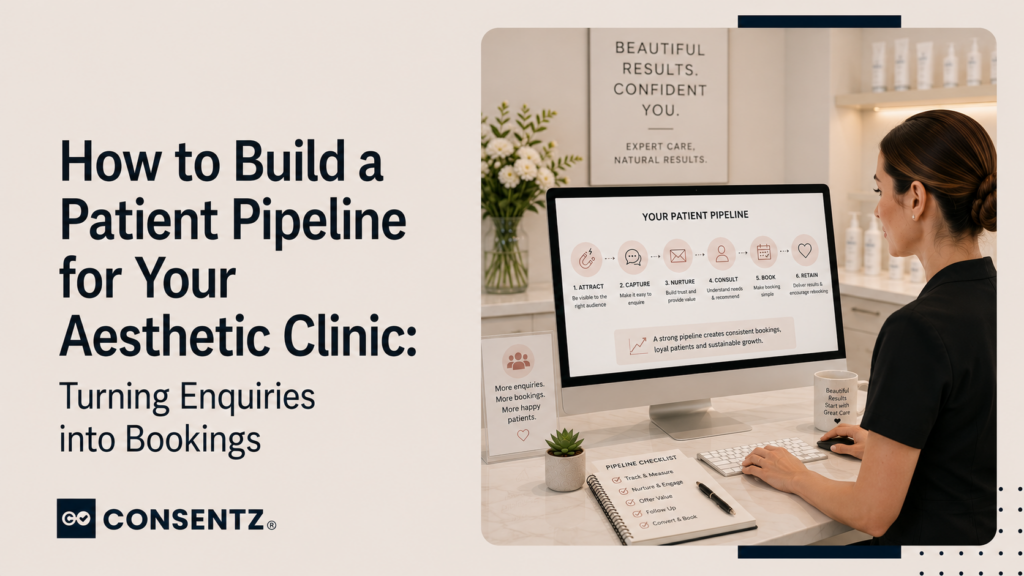
A patient pipeline is a structured view of where every potential patient sits in the journey from initial contact to first appointment. In its simplest form, it is five stages:
- Enquiry received: a message, form submission, or phone call from someone interested in a treatment
- Contacted: you have responded with relevant information, and they have not yet committed
- Consultation booked: they have a consultation or discovery call scheduled
- Treatment booked: they have committed to a treatment appointment, with a deposit
- Attended: they have had their first treatment and moved into your patient retention workflow, booking reminders, and invoice receipts. Not technically marketing, but patients see them more than any other email — and the branding and tone matter.
The point of making these stages explicit is visibility. Without a pipeline, you cannot see how many enquiries are sitting unanswered, how many people are stuck at the consultation stage, or where your conversion is actually breaking down. With a pipeline, you can see it at a glance — and act on it.
Why response time is your biggest conversion lever
Research consistently shows that response time to an initial enquiry is the single most important variable in whether that enquiry converts. Studies across service businesses show that responding within five minutes of an enquiry arriving makes conversion up to 21 times more likely than responding an hour later. Responding within an hour is seven times more effective than responding the next day.
Most aesthetic clinics — where the practitioner is in clinic for most of the day and cannot monitor DMs or form submissions in real time — are responding in hours, not minutes. This is where automation creates the biggest leverage: an instant, warm, automated first response that acknowledges the enquiry, provides the key information the patient asked about, and sets a clear next step is vastly more effective than a delayed personal response three hours later.
The automated first response does not need to replace the personal follow-up — it just holds the conversation until the personal follow-up arrives.
Bookings, consent forms, patient records, payments, marketing — Consentz is the aesthetic clinic software that puts it all in one place so you can focus on your patients, not paperwork.
The right number of follow-up attempts
One of the most common pipeline mistakes is giving up too early. Most aesthetic clinic enquiries do not convert on the first interaction — not because the patient has decided against, but because they are still in the research phase and have not been given enough reason to commit yet.
A sensible follow-up sequence for an unanswered aesthetic clinic enquiry:
- Immediate: automated response acknowledging the enquiry with key information and a clear next step (“to book a consultation, click here / call us on…”)
- Day 2: personal follow-up — a short, warm message from a named team member: “Just checking you received our information — happy to answer any questions before you book”
- Day 5–7: a gentle third touch — educational content relevant to what they enquired about, which adds value rather than repeating the booking push
- Day 14: a final message that lowers the commitment bar: “If now is not quite the right time, that is completely fine — would a brief call to answer questions be helpful?”
After four interactions with no response, move the contact to a longer-term nurture list rather than continuing to message. The relationship is more valuable than the immediate booking.
Tracking where your enquiries come from
A patient pipeline only delivers its full value when you also track the source of each enquiry — because that tells you which marketing channels are actually driving potential patients, and which are consuming budget without producing leads.
The key sources to track for an aesthetic clinic:
- Website contact form or booking page
- Instagram DMs and story replies
- Facebook Ads — leads from lead generation campaigns
- Google Ads — calls and form submissions
- Patient referrals — word of mouth, tracked by who referred them
- Google Business Profile — calls and messages from your Google listing
Without source tracking, you are flying blind on what to spend more on. A clinic that tracks sources typically finds that one or two channels drive the majority of converting enquiries — and several channels produce enquiries that never convert. The data changes where you invest.
Consentz’s Prospects module lets you record and track the source of every enquiry alongside its pipeline stage and conversion outcome. For a broader view of how the pipeline sits within your marketing strategy, see our guides on how to get more patients for your aesthetic clinic and the practice marketing software for aesthetic medicine overview.
Should I use a CRM or is my booking software enough?
A booking system manages patients who have already committed to an appointment. A CRM (Customer Relationship Management system) manages the people who have not committed yet — the enquiry stage, the follow-up, the nurture. They do different jobs.
Most basic booking tools have no prospect management capability: if someone messages your clinic expressing interest but does not book immediately, there is nowhere in the system to log that, track it, or follow up on it. Enquiries fall through the cracks not because staff are careless but because there is no system holding them.
Consentz includes a Prospects pipeline alongside its booking, records, and marketing modules — so enquiries from any source can be logged, tracked through pipeline stages, and followed up systematically without switching between tools. For a broader comparison of CRM options for aesthetic clinics, see our best CRM software for cosmetic clinics guide.
Frequently asked questions
1. How do I track where my enquiries come from?
The simplest method is to ask — when a patient books or contacts you, include “How did you hear about us?” as a field. For digital channels, UTM parameters on your website links allow Google Analytics to show you which campaigns drove which contact-form submissions. For Instagram, tracking is harder since DMs do not carry source data — but noting the source at the point of logging the enquiry in your pipeline is sufficient for most clinics. Consistency matters more than precision: a rough source split tracked over three months reveals more than no data at all.
2. How many touchpoints does it take to convert an aesthetic clinic enquiry?
Research across service businesses shows that most conversions happen between the second and fifth contact. Very few enquiries convert on the first interaction alone — most patients need to receive information, ask a question, and receive a response before they commit. This means a single follow-up after no response is almost always insufficient. A four-touch sequence over two weeks, as described above, captures a significantly higher proportion of viable enquiries than a single follow-up and drop.
3. What is the best way to follow up with someone who enquired but did not book?
Warm, helpful, and brief — not pushy. The follow-up that converts is the one that adds value rather than repeating the ask. “I noticed you enquired about lip filler last week — here is a short guide to what to expect” performs better than “Just following up to see if you would like to book”. For patients who have not responded to two or three touches, lower the commitment bar: offer a free five-minute phone consultation, or simply acknowledge that timing might not be right and invite them to reach out when it is.
4. Should I use a CRM or is my booking software enough?
For managing existing patients who are booking and returning, your booking software is usually sufficient. For managing the pre-booking enquiry stage — capturing leads, tracking follow-ups, recording sources — you need a prospect pipeline or CRM. Without one, you are not managing your new patient acquisition at all. Consentz includes both: the booking system and the prospect pipeline in the same platform, so enquiries and appointments are in one place rather than two separate tools.
5. How do I stop enquiries from falling through the cracks?
The only reliable answer is a system — a place where every enquiry is logged the moment it arrives, with a clear next action and a due date. If an enquiry exists only as a DM in Instagram or a mental note in someone’s head, it will fall through. A Kanban-style pipeline (columns for each stage, cards for each enquiry) makes the entire pipeline visible at a glance so nothing slips. Combine this with automated first responses so that even enquiries arriving out of hours are acknowledged immediately.