You have spent real money acquiring every patient on your list. Consultation marketing, Google Ads, social media, word of mouth that took months to build — none of it came free. So when a patient comes in once, has a good experience, and then quietly disappears for six months, that investment walks out the door with them.
The good news is that most lapsed patients did not leave because they had a bad experience. Research consistently shows they left because life got busy, they forgot, or nobody reached out to remind them they were missed. That is a recoverable situation. A well-run recall campaign turns dormant names in your system into booked appointments — often at a fraction of what it costs to acquire a new patient.
This guide covers how to build that system from scratch: who to target, what to say, how to automate it, and what to measure.
Why most patients lapse (and why it matters for your approach)
Understanding why a patient lapsed changes how you should re-engage them:
- They got busy and forgot: the most common reason. Fix: a well-timed, friendly message that lands when the treatment interval is due. No guilt, no pressure.
- They were not sure if they needed another treatment yet: fix: educational content that helps them understand why treatment timing matters — not a promotional email.
- They were quietly comparing options: fix: a message that reminds them of their specific results with you — their trust in you is already earned, you just need to reactivate it.
- Something financial changed temporarily: fix: sensitivity. An offer framed as added value (“book this month and include a skin consultation at no extra cost”) lands better than an outright discount that signals desperation.
Most lapsed patients are re-engageable. Studies show that 70–80% of patients who receive a genuine, personalised follow-up are likely to rebook. The failure mode is not the patient — it is the clinic that does not follow up at all.
Who counts as a lapsed patient?
Define “lapsed” based on the expected treatment interval, not an arbitrary number of months. A patient who has not been back in 90 days might be perfectly on schedule for a dermal filler refresh — or might be overdue, depending on the treatment. A patient who has not been back in 12 months is almost certainly lapsed regardless of treatment type.
A practical starting point for most aesthetic clinics:
- Injectables (Botox, lip filler): lapsed at 10–14 weeks after last treatment
- Dermal fillers (cheeks, jawline): lapsed at 7–9 months
- Skin treatments (peels, microneedling, laser): lapsed at 8–12 weeks depending on protocol
- General lapsed (no specific treatment filter): any patient not seen in 90+ days is worth a gentle re-engagement
Bookings, consent forms, patient records, payments, marketing — Consentz is the aesthetic clinic software that puts it all in one place so you can focus on your patients, not paperwork.
How to segment your lapsed patients before you send anything
Sending the same message to every lapsed patient on your list is the most common recall campaign mistake. A patient who has not been back for six weeks needs a different message than one who has not been back for eighteen months. A Botox patient needs different content than a skin peel patient.
Segment by how recently they lapsed
A tiered approach works best:
- 90 days to 6 months: warm, friendly tone. They are probably overdue and know it. “We miss you” with a direct booking link performs well here.
- 6 to 12 months: a bit more context. Remind them of what they had and why the timing matters. A “since your last visit” message with their treatment history referenced.
- 12+ months: more of an “are you still interested?” approach. Lead with education rather than a booking push. Keep the bar low: a consultation to review their current skin or treatment goals works better than a hard “book now”.
Segment by treatment type
Build separate recall sequences for different treatment categories. A Botox recall message should mention Botox — the specific treatment the patient knows, used, and trusted you with. A filler patient should receive messaging that speaks to their filler results. Generic messaging that could apply to any patient at any clinic converts at significantly lower rates than messages that reference what the patient actually had.
Build a 5–10 minute buffer after certain appointment types. This is configurable per treatment in Consentz — so a 20-minute Botox appointment can have a 10-minute buffer automatically added, preventing the next booking from landing immediately after.
Segment by engagement channel
Some patients opened every email you sent. Others only responded to SMS. Use your historical communication data to route the right message to the right channel. If you do not have this data, default to SMS first — text messages have a 98% open rate and most are read within three minutes of delivery.
What to say — and what not to say
Lead with results, not discounts
“Your skin deserves a refresh going into summer” outperforms “Save 15% when you book this month” for existing patients. Both might drive bookings — but the first one connects to why the patient cares, and it does not erode your pricing. Existing patients who trust you do not need a discount to come back. They need a reminder and an easy path to booking.
Discounts can be effective for patients who have been gone for 12+ months and may need a stronger nudge — but frame them as added value rather than percentage off. “Book a Botox top-up this month and include a complimentary skin analysis” lands better than “20% off Botox”.
Reference their specific treatment history
“Last spring you came in for Botox and loved the result — it has been almost four months” is dramatically more effective than a generic clinic message. Personalisation does not require complex software — it requires your clinic system to be able to filter patients by their last treatment and use that information in the message.
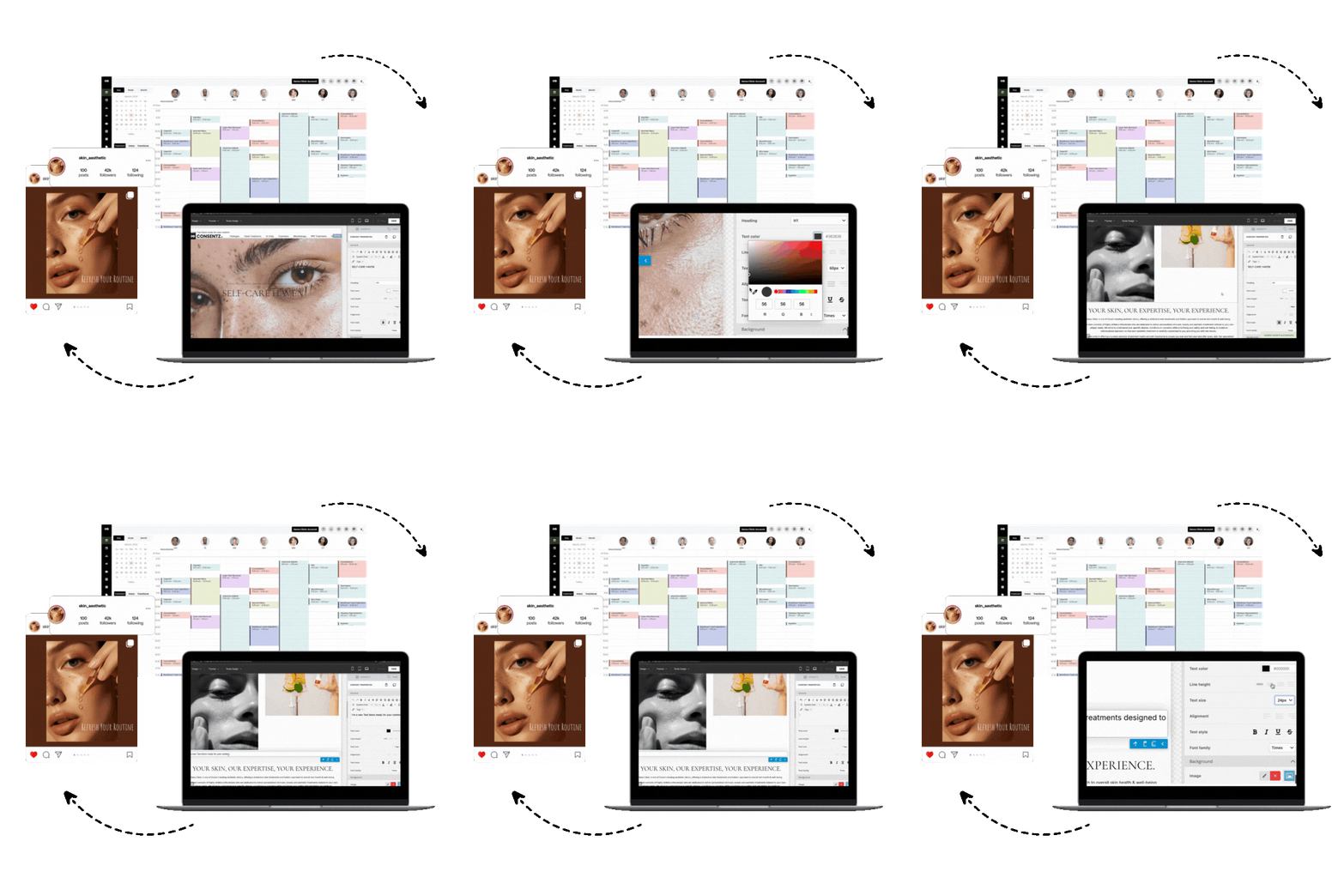
Consentz’s campaign manager allows you to filter by last visit date, treatment type, and patient history, and use those fields as personalisation tokens in your email and SMS templates. The message references the patient’s actual experience with you — not a generic assumption.
The right number of re-engagement attempts
For a standard recall sequence, three touches over a two-week window is a reasonable approach:
- SMS at the point the recall interval is reached — short, direct, with a booking link
- Email three to five days later if no action — slightly more detailed, with a reminder of why the treatment timing matters
- Final SMS seven to ten days later if still no action — simple, non-pressuring close: “If now is not the right time, no problem — just let us know when to reach out again”
If a patient does not respond to three appropriately-spaced messages, they are either genuinely not interested right now or the message is landing in the wrong channel. Do not send more than three messages in a single sequence — the relationship is more valuable than the booking.
How to automate your recall campaigns
Manual recall campaigns get done once and then abandoned when the clinic gets busy. Automation is what makes recall sustainable — because the trigger is the patient’s treatment interval, not a decision by a staff member to run a campaign this week.
Consentz’s automated campaign feature allows you to build recall sequences that trigger based on last visit date and treatment type. Once the sequences are built:
- Botox patients get a recall message automatically at 10 weeks
- Filler patients get a recall at 6 months
- Skin treatment patients get a recall at 8 weeks
- A general lapsed-patient sequence triggers at 90 days for anyone not already in a treatment-specific sequence
None of this requires a staff member to pull a list, write a message, and send it manually. The system does it based on the rules you set — and it runs every day, for every patient who reaches the threshold, whether your team is in clinic or not.
What to measure
Track these metrics monthly to assess recall campaign performance:
- Recall booking rate: what percentage of re-engagement messages result in a booking
- Revenue recovered: bookings generated directly from recall messages, by treatment type
- Opt-out rate: if patients are opting out of communications after a recall sequence, the frequency or tone is wrong
- Best-performing message: test different subject lines, different opening lines, SMS versus email — small changes often produce measurable differences in booking rate
Most aesthetic practices could generate an additional £15,000–£50,000 per year purely from reactivating patients who already exist in their system. That revenue is sitting dormant in your contact list — it just needs a systematic, automated process to wake it up.
Frequently asked questions
1. How do I know which patients have not been back in 3 or more months?
Your clinic management software should be able to filter patients by their last visit date. In Consentz, you can segment your patient list by last appointment date and treatment type — producing an instant list of anyone who has not returned within your defined recall window. If you are currently doing this manually in a spreadsheet, that is the first process to move into your booking system.
2. What should a patient recall email say to not sound desperate?
Lead with the patient’s results and the timing, not with an offer. “We noticed it has been about four months since your Botox appointment — most patients find their results start to fade around now” is informative and helpful. “We miss you, here is a 20% discount” signals that business is slow. Tone matters enormously in aesthetics because your patients chose you for a reason that is not price. Recall messaging that feels caring and relevant reinforces that reason. Messaging that feels promotional undermines it.
3. How automated can recall campaigns be?
Fully automated — once built. You configure the trigger (e.g. 10 weeks after a Botox appointment), the message, the channel (SMS, email, or both), and the follow-up sequence. After that, the system runs it for every patient who meets the criteria, every day, without any manual input from your team. The only ongoing task is reviewing the results monthly and adjusting messages that are underperforming.
4. Is SMS or email better for recall messages?
SMS for the first touch, email for follow-up detail. SMS has a 98% open rate and is read within minutes — ideal for the initial short, direct recall message with a booking link. Email is better for slightly longer content where you want to include more context (why treatment timing matters, what to expect at the appointment) or a more detailed personalised recap of the patient’s history with you. Use both rather than choosing one.
5. How many times should I try to re-engage a lapsed patient before giving up?
Three messages over a two-week window is the sweet spot for most aesthetic recall sequences. More than three in quick succession feels intrusive and can damage the relationship. If a patient does not respond after three appropriately-spaced messages, they either are not ready right now or have moved on. The most professional close is the third message: “If now is not the right time, that is completely fine — we will check in again when your treatment window comes around.” This respects the patient’s autonomy and leaves the door open without pressure.