Welcome to the vibrant world of aesthetics in Georgia! Whether you’re dreaming of opening a serene spa in Savannah or a cutting edge medspa in Atlanta, your journey begins with a solid understanding of the rules. The core aesthetic license requirements in Georgia involve completing at least 1,000 hours of training, being 18 years old with a high school diploma or GED, and passing both written and practical state board exams. Navigating these details is the essential first step to building a safe, legal, and successful career. This guide breaks down everything you need to know, from school to advanced practice regulations, in a simple, human way. If you’re mapping out the business side, our step-by-step guide to opening a med spa can also help.
Getting Started: The Path to Your Esthetician License
Before you can work your magic on clients, you need to meet the foundational requirements set by the Georgia State Board of Cosmetology and Barbers. Think of this as building the strong base for your career.
Training: The 1,000 Hour Foundation
The cornerstone of your qualification is hands on training. The state of Georgia wants to ensure you are thoroughly prepared. Here are the paths you can take:
- Standard Program: Complete an esthetics program of at least 1,000 hours at a board approved school. This training must span a minimum of nine months.
- Technical College: Earn 33 semester credit hours from a technical college, which covers the same 1,000 hour curriculum.
- Apprenticeship: A less common but available route involves completing 2,000 hours of supervised training under a licensed professional over at least 18 months.
Age and Education Prerequisites
Georgia has specific age and education benchmarks you need to hit. While cosmetology law historically set the bar around completion of the 9th grade, modern standards are higher for full licensure.
- Minimum Age: You can enroll in an esthetics program or start an apprenticeship at 16 years old. However, you must generally be at least 18 years old by the time you apply for your license.
- Minimum Education: To get your license, you must have a high school diploma or a GED. This ensures you have the foundational knowledge for the scientific and business aspects of the profession.
The Application Process and Fees
Once your training is complete, it’s time to make it official. The process involves submitting a formal application and paying several fees. Be prepared for costs associated with your application, exams, and the initial license itself. If you’re budgeting for the bigger picture, see how much it costs to open a med spa. The initial application fee is non refundable and typically costs around $30, while exam fees paid to the testing provider are about $109 for both the written and practical portions.
Background Checks: What You Need to Disclose
While Georgia does not require a formal fingerprint background check for an esthetician license, it does require honesty. Your application will include questions about your criminal history. You must disclose any past convictions, and if you do, you’ll need to provide supporting court documents. The Board reviews these on a case by case basis to determine fitness for licensure.
Acing the Georgia State Board Exams
The state board exams are your final hurdle before becoming licensed. They are designed to test your theoretical knowledge and your practical, hands on skills to ensure you are ready to serve the public safely.
Understanding the Written and Practical Exams
You must pass two separate exams:
- Written (Theory) Exam: A computer based, multiple choice test covering scientific concepts, skin anatomy, sanitation, infection control, and state laws.
- Practical (Hands On) Exam: A skills demonstration where you perform a series of esthetic services on a mannequin in front of an examiner. You’ll be graded on technique, safety, and sanitation.
Meet the Exam Provider: The NIC
Georgia uses exams developed by the National Interstate Council of State Boards of Cosmetology (NIC). The NIC creates standardized tests used across many states, ensuring a consistent and fair evaluation of your skills. While the NIC creates the exam content, you will schedule and take your test with Georgia’s contracted provider, PSI Services.
What’s the Passing Score?
To pass the state boards, you must achieve a minimum score of 70% on each part of the exam (both written and practical). Some industry resources mention a score of 75, which can be a benchmark in other states or for different exams, but for the Georgia esthetician license, the magic number is 70.
Requesting Disability Accommodations
In compliance with the Americans with Disabilities Act (ADA), the Georgia board provides reasonable accommodations for candidates with documented disabilities. This can include extra time, a private room, or a reader. You must submit a formal request with supporting documentation well in advance of your exam date.
Maintaining and Advancing Your License
Getting your license is a huge accomplishment, but the work doesn’t stop there. Maintaining your license and exploring advanced credentials are key to a long and rewarding career.
License Renewal: Deadlines and CE Hours
Your Georgia esthetician license requires ongoing attention to remain active.
- Renewal Deadline: Esthetician licenses expire on August 31 of odd numbered years (e.g., 2025, 2027).
- Continuing Education: You must complete 5 hours of Continuing Education (CE) every two year renewal period. At least 3 of these hours must be in Health and Safety courses approved by the board.
What if Your License Lapses? Reinstatement Rules
If you miss the renewal deadline, your license will become lapsed. To restore it, you must file a reinstatement application, pay all back fees and penalties, and provide proof of completing the required CE hours for the period you missed.
Moving to Georgia? Licensure by Endorsement (Reciprocity)
If you are a licensed esthetician in another state, you may be able to get a Georgia license through endorsement. Comparing states? Review California cosmetology laws and license requirements for context. This process, often called reciprocity, is possible if your original state’s requirements for training hours and exams are substantially similar to or greater than Georgia’s.
Becoming an Esthetics Instructor
Ready to share your knowledge? To become a licensed Esthetics Instructor in Georgia, you must:
- Hold a current Georgia esthetician license.
- Have at least one year of documented work experience as a licensed esthetician.
- Complete a board approved instructor training program.
- Pass both written and practical instructor exams.
- Instructors have a higher CE requirement of 15 hours per renewal cycle.
Your Professional Responsibilities in Georgia
Being a licensed professional comes with responsibilities, from understanding the proper way to apply to knowing the legal boundaries of your practice.
Applying Online Through the GOALS Portal
Georgia has streamlined the application process with its Georgia Online Application Licensing System (GOALS). This portal allows you to apply for your initial license, renew, and manage your information completely online. You’ll create an account, fill out the application, upload your documents, and pay your fees all in one place.
Special Considerations for Veterans
Georgia offers a Veteran’s Preference Policy to support military service members, veterans, and their spouses. This can provide benefits like expedited application processing and the addition of 5 points to a passing exam score. You must provide documentation, such as a DD 214 form, to qualify.
Understanding Your Scope of Practice
This is one of the most critical aesthetic license requirements in Georgia. Your license allows you to perform non medical, cosmetic treatments on the epidermis (the outermost layer of skin). However, there are strict limitations. Estheticians in Georgia are prohibited from performing:
- Injectables: Administering Botox, dermal fillers, or any other substance by injection.
- Laser Services: Using lasers or Intense Pulsed Light (IPL) for hair removal or skin rejuvenation. Georgia has separate licensing for cosmetic laser practitioners under the Medical Board.
- Deep Chemical Peels: Applying peels that penetrate beyond the epidermis into the dermis.
Essentially, if a procedure is designed to affect living tissue or constitutes a medical treatment, it is outside the esthetician’s scope of practice.
Navigating the Rules for Medical Aesthetics in Georgia
For those working in a medical spa or clinic, the rules become even more specific, especially when nurses are involved. You’ll also need to stay compliant with privacy rules; here’s a practical overview of HIPAA requirements for a med spa. These regulations are set by the Georgia Board of Nursing and are designed to protect patients.
Can a Registered Nurse (RN) Perform Injections?
Yes, an RN in Georgia can perform cosmetic injections, but only under strict supervision. An RN may only administer injectables after a physician, PA, or NP has performed an in person history and physical exam and written a direct, individualized prescriber order for that specific patient and treatment. If you’re setting up your supervision model, here’s guidance on how much to pay a medical director for a med spa.
Are Licensed Practical Nurses (LPNs) Allowed to Inject?
No. The Georgia Board of Nursing has made it clear that it is not within the scope of practice for an LPN to perform cosmetic injections, even with a doctor’s order.
Why Individualized Orders are Mandatory (And Standing Orders Are Not)
An individualized order ensures that every patient receives a personalized medical evaluation and treatment plan. The Board of Nursing explicitly prohibits the use of “standing orders” or general protocols for cosmetic procedures. This prevents a one size fits all approach and guarantees that a qualified prescriber is making the medical decisions for each patient.
Competency and On Site Policies for Nursing Procedures
Any facility offering cosmetic nursing services must have written policies and procedures on site. This includes protocols for performing treatments safely and, critically, for handling emergencies and complications. Nurses must also be able to demonstrate competency and proper training for any procedure they perform.
The RN’s Role: Implementation, Not Diagnosis
An RN’s role in aesthetics is to implement the treatment plan, not create it. An RN cannot diagnose skin conditions or independently develop a treatment plan. These actions are the practice of medicine and are reserved for physicians, PAs, and NPs.
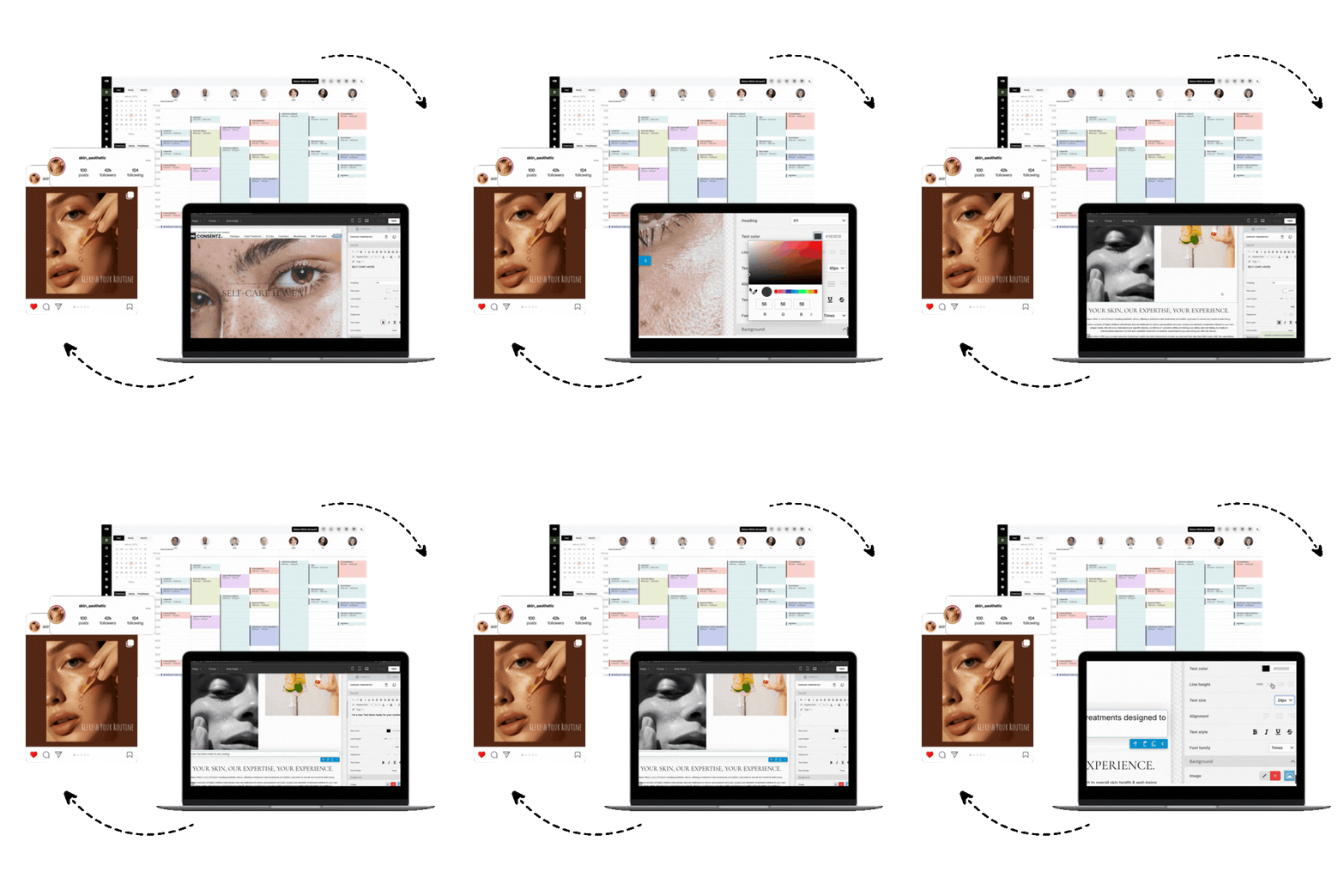
Staying on top of these complex regulations is crucial. For clinics managing multiple practitioners, an all in one platform like Consentz’s medspa EMR software can help track credentials and enforce compliance, ensuring that procedures are only assigned to staff with the appropriate license and training.
Frequently Asked Questions About Aesthetic License Requirements in Georgia
How long does it take to meet the aesthetic license requirements in Georgia?
Most full time students complete their 1,000 hours of training in about 9 to 12 months. After that, you must schedule and pass your state board exams and have your license application processed, which can take several more weeks.
What is the most important part of the Georgia esthetician practical exam?
While all sections are important, examiners pay extremely close attention to safety and sanitation. Consistently maintaining a sanitary work area, properly disinfecting implements, and protecting your client (mannequin) are critical for passing.
Can I get my Georgia esthetician license if I have a license from another state?
Yes, through a process called endorsement. The Georgia Board will review your home state’s licensing requirements. If they are equal to or greater than Georgia’s (1,000 training hours and passing a written and practical exam), you can typically be granted a license without retesting.
What are the continuing education aesthetic license requirements in Georgia?
You must complete 5 hours of continuing education every two years to renew your license. At least 3 of those 5 hours must be on the topic of Health and Safety.
Compliance and excellence in aesthetics go hand in hand. Keeping up with the aesthetic license requirements in Georgia is a non negotiable part of being a trusted professional. It protects you, your clients, and your business.
Modern tools can make this much easier. For instance, Consentz is a clinic management software purpose built for medical aesthetics practices. It helps you streamline everything from scheduling to patient records while maintaining compliance. For a deeper look at calendars, reminders, and waitlists, explore our clinic scheduling software for aesthetics. With features like staff credential tracking and role based permissions, you can ensure your team always operates within the legal scope of their license. If you’re ready to grow your practice with a platform that supports both your artistry and your regulatory duties, explore what Consentz’s clinic management software can do for you.