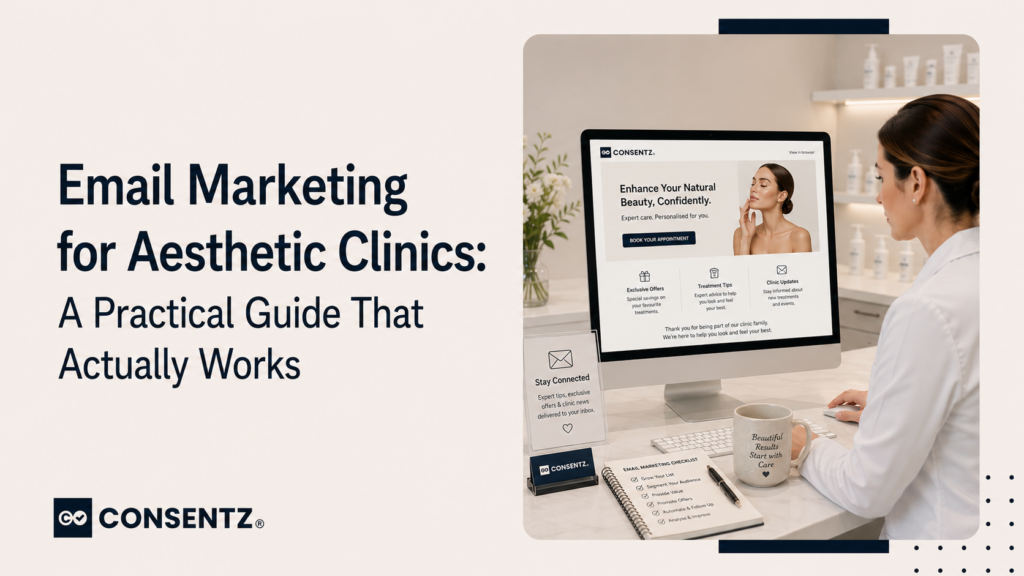
Most aesthetic clinic email lists are a largely untapped asset. Practitioners spend weeks building a patient database, then send the occasional newsletter about seasonal offers or a new treatment they have added — and wonder why open rates hover around 18% and bookings barely move.
The problem is not email marketing itself. Email consistently delivers one of the highest returns on investment of any marketing channel for service businesses — higher than social media advertising for most clinics when used correctly. The problem is approach: generic, infrequent, broadcast emails sent to the whole list regardless of what each patient has actually had.
This guide covers how to make email marketing actually work for an aesthetic clinic — the structure that drives bookings, the GDPR rules that determine what you can send, and the segmentation that turns a flat list into a personalised, revenue-generating system.
The three types of email every aesthetic clinic should be sending
Most clinics conflate all email into one bucket: the campaign blast. In practice, there are three distinct types of email, each with a different purpose and a different level of automation:
- Broadcast campaigns: a message sent to a defined segment of your list at a specific time — a seasonal promotion, a new treatment launch, a staff update. These require active creation and are sent on your schedule.
- Automated sequences: emails triggered by a patient action or time interval — a welcome sequence when someone joins your list, a post-treatment follow-up 48 hours after an appointment, a recall email when a treatment interval is due. Appointment reminder automations also directly reduce no-shows — see how to reduce no-shows at your aesthetic clinic for the full approach. These sequences are built once and run continuously.
- Transactional emails: system-generated messages like appointment confirmations, booking reminders, and invoice receipts. Not technically marketing, but patients see them more than any other email — and the branding and tone matter.
Most clinics focus entirely on broadcast campaigns and ignore automated sequences. This is back to front. Automated sequences — post-treatment follow-ups, treatment-interval recalls, welcome emails — have significantly higher open rates and conversion rates than broadcast campaigns because they arrive at the moment they are most relevant to the individual patient.
GDPR and email marketing — what you can and cannot send
Before you send anything, the GDPR compliance question needs to be clear. There are two situations:
Patients who have had a treatment with you (the soft opt-in)
Under UK GDPR and the Privacy and Electronic Communications Regulations (PECR), you can email existing patients about similar products and services without obtaining fresh marketing consent — provided you gave them a clear opportunity to opt out when you first collected their details, and you offer an easy opt-out in every message. This is the soft opt-in rule, and it is the legal basis for most aesthetic clinic recall and retention campaigns.
Critically: the soft opt-in only covers directly similar services. A dermal filler clinic emailing about laser treatments it is adding to its menu is likely fine. The same clinic emailing about an unrelated wellbeing product is not. When in doubt, treat the campaign as requiring explicit consent.
New contacts or general marketing campaigns
For people who have not treated with you, or for marketing campaigns that go beyond directly similar services, you need explicit opt-in consent. This means a clear, unticked checkbox at the point of collection, and a record of when and how consent was given. Consentz tracks marketing consent per patient and links it to each communication — so your GDPR audit trail is automatic.
For more on GDPR compliance in your clinic, see the GDPR guides in the Consentz blog. For the wider picture on running a paperless clinic with proper consent tracking, see our guide on going paperless in your aesthetic clinic.
Bookings, consent forms, patient records, payments, marketing — Consentz is the aesthetic clinic software that puts it all in one place so you can focus on your patients, not paperwork.
Segmentation — the one thing that separates effective from ineffective clinic email
Role-based calendar access — who sees what
Sending the same email to every patient on your list is the fastest way to train patients to ignore you. A patient who had lip filler last month is not the same audience as a patient who had microneedling six months ago. Treating them identically means your email is not relevant to either.
The segments that matter most for an aesthetic clinic:
- By last treatment type: Botox patients, filler patients, skin treatment patients, laser patients each have different treatment intervals, different product interests, and different educational content that is relevant to them.
- By time since last visit: active patients (within their normal treatment cycle) need different content than lapsed patients (overdue for a return). Do not send a first-visit welcome email to someone who has been with you for three years.
- By new vs returning: new patients need trust-building content (what to expect, aftercare, your credentials). Returning patients need personalised recall and cross-sell content.
- By engagement: patients who open every email and click links are warm. Patients who have not opened anything in six months need a different approach — or a re-permission campaign before you conclude they have lapsed.
Consentz’s campaign manager lets you filter your patient list by treatment type, last visit date, and history — so each campaign goes to the patients it is actually relevant to, not the whole list regardless of their situation. See our healthcare marketing software page for more on how this works in practice. For a comparison of which clinic software platforms have the strongest built-in marketing tools, see our guide to which aesthetic clinic software has the best marketing features.
How often to email your patients
The honest answer: more often than most clinics do, and more deliberately than most clinics manage.
A sensible email calendar for an aesthetic clinic:
- Weekly automated triggers: recall emails, post-treatment follow-ups, and review requests fire automatically based on patient behaviour. These are not bulk emails — they are individual, relevant messages.
- Monthly broadcast: one general campaign per month — a treatment spotlight, an educational piece, a seasonal angle. One well-crafted email per month maintains brand presence without fatiguing your list.
- Quarterly launches: new treatment introductions, waiting list announcements, and limited-slot promotions. These create events on your email calendar and give patients a reason to pay attention.
What unsubscribes your patients: poorly targeted offers (a laser promotion sent to someone who came in for Botox and has never mentioned skin concerns), excessive frequency in broadcast campaigns, and heavy discounting that devalues your brand positioning. One clear, relevant email is worth ten generic blasts.
Subject lines — what actually gets opened
Open rates in aesthetic clinic email average around 20–28% for well-segmented lists. The subject line is almost entirely responsible for whether you land in that range or below it.
What works in aesthetic clinic email subjects:
- Personalisation + timing: “[First name], your Botox appointment was 10 weeks ago” or “It has been 6 months since your filler top-up” outperform generic seasonal subjects consistently
- Specificity over cleverness: “5 things to know before your first Botox appointment” performs better than “What your skin wants you to know this autumn” — specificity tells the reader exactly what they will get
- Question format for educational emails: “Should you have Botox before or after a facial?” creates curiosity without being misleading
What kills open rates: subject lines with the word “newsletter”, all-caps urgency, excessive punctuation, and vague teases that do not give the reader a reason to open. Test two subject lines on a small segment before sending to the full list — a two-line A/B test takes five minutes and consistently shows double-digit differences in open rate.
For the full picture on marketing your clinic, see our guides in the Aesthetic Clinic Marketing category. If you are building out your patient acquisition pipeline alongside email, see how to build a patient pipeline for your aesthetic clinic.
Measuring whether your email is working
Email is one part of a broader patient growth and retention system. For the full picture on retaining patients long-term, see how to increase patient retention in aesthetic clinics. For growing your organic visibility alongside email, see the local SEO guide for aesthetic clinics.
Track these four metrics monthly:
- Open rate (target 25%+): below 20% suggests a subject line problem, a list hygiene issue (too many cold addresses), or irrelevant content
- Click-through rate (target 3–6%): the percentage who click a link in the email. Low click rates usually mean the email content is not compelling enough or the CTA is buried
- Booking rate from email: how many appointments were booked within 48 hours of an email send. This is the metric that connects email to revenue
- Unsubscribe rate (stay below 0.5% per send): spikes indicate a mismatch between audience and content — the email went to the wrong segment or was sent too frequently
Frequently asked questions
1. How often should I email my patients — is monthly too much or too little?
Monthly broadcast campaigns are fine as a baseline — most well-segmented clinic lists can handle one thoughtful email per month without fatiguing. Where many clinics underinvest is in automated emails: post-treatment follow-ups, treatment-interval recalls, and post-visit review requests should be running continuously, triggered by individual patient events, not by a calendar date. These automated emails have higher open rates than any broadcast campaign because they arrive at the right moment for each patient.
2. What kind of subject lines actually get opened?
For recall and retention emails: personalised subjects that reference the patient’s specific treatment and timing consistently outperform generic subjects. u0022Your Botox top-up window is coming upu0022 outperforms u0022Spring offers at the clinicu0022. For educational emails: specific, question-format subjects (u0022How long does dermal filler actually last?u0022) outperform vague teasers. For new treatment announcements: list-format subjects (u00223 things to know about our new skin peelu0022) perform well because they set a clear expectation before the patient opens.
3. How do I segment my email list by treatment type?
Your clinic management software should be able to filter patients by their last treatment or treatment history. In Consentz, you can build targeted lists in the campaign manager filtered by treatment type, last visit date, and patient history — producing a segmented list for each campaign without manual sorting. If you are currently doing this in a spreadsheet, that is the first process to move into your clinic platform.
4. Should I offer discounts in emails or does it cheapen the brand?
Discounts cheapen the brand for existing patients who already value your work — and train them to wait for the next promotion rather than booking at full price. For existing patients, framing is more effective: added value (u0022book this month and include a complimentary skin analysisu0022), exclusive access (u0022we are opening early booking for our new treatment to existing patients firstu0022), or urgency based on clinical timing (u0022your treatment interval is coming up — a limited number of slots remainu0022). Reserve percentage-off discounts for specific re-engagement purposes, like winning back genuinely lapsed patients who have been gone 12+ months.
5. Do I need GDPR consent to email patients who have already treated with me?
Not necessarily — the soft opt-in rule under UK GDPR and PECR allows you to email existing patients about directly similar services, provided you gave them a clear opt-out opportunity when collecting their contact details and you include an easy unsubscribe in every email. However, you still need to record that they are eligible under the soft opt-in, and you should not email them about unrelated products or services without explicit consent. Always give patients an easy way to unsubscribe from any message.