Thinking about starting a career in skincare in the Hawkeye State? That’s fantastic. To become a licensed esthetician, you must first navigate the official process. The core aesthetic license requirements in Iowa include completing 600 training hours, passing the NIC Theory Exam with a score of 75% or higher, and paying a $60 application fee. Understanding these specifics and the broader Iowa cosmetology laws and license requirements is your first and most important step. We’ve broken it all down into a clear, comprehensive guide to help you get started.
From schooling and exams to advanced certifications, here’s everything you need to know to launch your esthetics career in Iowa. If your long‑term goal is to run your own clinic, here’s what license you need to open a medical spa.
Core Educational and Application Steps
Before you can even think about advanced treatments, you have to build a solid foundation. The initial aesthetic license requirements in Iowa focus on your education and formal application to the state board.
High School Diploma or Equivalent
First things first, most states require a basic level of education before you can enroll in a beauty program. This ensures you have the foundational reading and communication skills needed for the coursework. Iowa, like many other jurisdictions, requires applicants to have a high school diploma or a GED equivalent to be eligible for an esthetician license.
The 600 Hour Esthetics Course
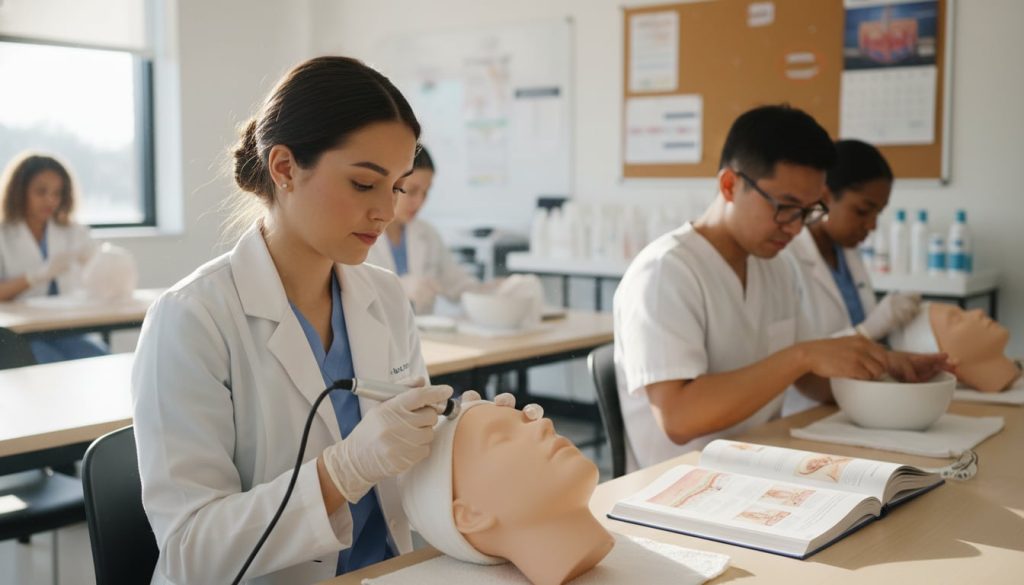
The heart of your training is your esthetics program. In Iowa, the state mandates that you complete a minimum of a 600 hour esthetics course from a board approved school. This is a common benchmark across the country, with about one third of states using 600 hours as the standard for entry level licensure.
Your 600 hours will be packed with essential knowledge and hands on practice covering topics like:
- Skin anatomy and analysis
- Facial techniques and massage
- Hair removal methods
- Makeup application
- Crucial sanitation and safety protocols
Submitting Your Application and Transcripts
Once you’ve graduated, it’s time to make it official. You’ll begin by submitting the board application form. This is your formal request for a license, where you provide personal details and attest that you’ve met all prerequisites.
A key part of this process is providing proof of your education. Your beauty school must send your official transcript or diploma directly to the Iowa board. You cannot submit a copy yourself. This rule is in place to prevent document tampering and ensures the board receives verified confirmation of your completed 600 training hours.
Passing the Exam and Paying the Fees
With your education complete and application in progress, the next major hurdles are the state board exam and the associated fees.
The NIC Theory Exam (and that 75% Passing Score)
To prove your competency, you must pass a board approved exam. Iowa uses the National Interstate Council of State Boards of Cosmetology (NIC) National Esthetician Theory Exam. This is a standardized, computer based test with multiple choice questions covering the core concepts you learned in school. To meet the aesthetic license requirements in Iowa, you must achieve a passing score of 75% or higher.
The $60 Nonrefundable Application Fee
Applying for your license involves a small administrative cost. In Iowa, the application fee for an esthetician license is $60. It’s important to know that this fee is nonrefundable, meaning you won’t get it back even if your application is denied. This fee covers the board’s cost of processing your paperwork and issuing your license. When you start seeing clients, set up proper invoicing. This clinic billing software guide for aesthetics clinics outlines the options.
Licensing for Out of State and Alternative Paths
What if you’re already licensed in another state or want to explore non traditional training? The aesthetic license requirements in Iowa have provisions for these situations.
Moving to Iowa? License Verification and Reciprocity
If you’re a licensed esthetician moving to Iowa, the state doesn’t offer automatic reciprocity. Instead, it offers licensure by endorsement. This means you’ll need to:
- Prove you hold an active license in another state that is in good standing.
- Request an official license verification from your previous state’s board to be sent directly to the Iowa board.
- Demonstrate that your original state’s training and exam requirements are substantially equivalent to Iowa’s.
If your training hours were lower than Iowa’s 600 hour standard, you may need to provide proof of work experience to make up the difference.
The Apprenticeship Route: The 2000 Hour Program
While a 600 hour school program is the most common path, some states offer an alternative. An establishment training program, or apprenticeship, allows you to learn on the job under a licensed professional. This route requires significantly more time, often around 2000 hours, to ensure you gain equivalent experience. Currently, 19 U.S. states allow for an esthetician apprenticeship pathway, providing a great option for those who prefer to earn while they learn.
Getting a Temporary Permit
Some states offer a temporary permit that allows graduates to work under supervision while waiting to take their exam or for their official license to be processed. These permits are typically valid for a short period, like 90 days, and are not renewable. It’s a great way to start gaining professional experience right after graduation, but you must check with the Iowa board for current availability and conditions.
Expanding Your Skills: Advanced Certifications in Iowa
Your initial license is just the beginning. To offer more advanced and in demand services, you’ll need to meet additional aesthetic license requirements in Iowa through specialized training and certification.
Microdermabrasion, Lasers, and IPL
Want to offer advanced exfoliation or light based therapies? In Iowa, you need separate board certifications.
- Microdermabrasion: Requires a minimum of 14 contact hours of training on the specific device you will be using.
- Laser and Intense Pulsed Light (IPL): Requires a substantial 40 hours of dedicated training for each specific laser or IPL model you plan to operate.
After completing the training, you must submit proof to the board and pay a certification fee to legally perform these services.
Chemical Peel Certification
Similar to other advanced treatments, performing chemical peels beyond very superficial exfoliation requires certification. Iowa requires at least 21 hours of training focused on the specific chemical peel products and processes you will use. The training must cover safety, application, and contraindications. Remember, estheticians are limited to peels that remove surface epidermal cells only; anything deeper is considered a medical procedure.
Extraction Training
Extractions are a core skill taught in every 600 hour program. However, the scope of what you can do may be limited. While basic extractions using gloved fingers or a comedone extractor are standard, using a lancet to open a closed comedone may be restricted or require advanced training, depending on state rules.
Permanent Makeup and Tattooing Laws (Section 10A.531)
Many estheticians are interested in offering services like microblading or permanent eyeliner. It is critical to understand that in Iowa, permanent makeup (cosmetic micropigmentation) is regulated as tattooing. Your esthetician license does not cover these services. To offer them, you must obtain a separate tattoo permit from the Iowa Department of Public Health and comply with all body art regulations under Iowa Code Section 10A.531.
Safety, Scope, and Staying Compliant
Advanced services come with increased responsibility. Iowa’s regulations place a strong emphasis on safety and understanding your professional limits. Beyond scope‑of‑practice rules, review the HIPAA requirements for a med spa to keep client data protected.
The Mandatory Safety Component for Laser and IPL
Any board approved training for laser and IPL services must include a robust safety component. This covers potential hazards, infection control, client and practitioner eye protection, and emergency protocols. Iowa regulations even require practitioners to report any client injury requiring medical attention to the board within 30 days.
Understanding Laser Use Limitations
As an esthetician in Iowa, your use of lasers is limited to cosmetic procedures on the surface epidermal layer of the skin. Any treatment that affects deeper tissue is outside your scope of practice. Interestingly, while a certified esthetician can perform laser skin rejuvenation, laser hair removal falls under the scope of a licensed electrologist in Iowa.
Streamlining Your Practice From Day One
Once you’ve successfully navigated the aesthetic license requirements in Iowa, the next step is managing your new business. From tracking your license renewal dates and advanced certifications to scheduling clients and managing consent forms, staying organized is key to success. This is where HIPAA‑compliant medical spa software makes all the difference.
An all in one platform built for aesthetic practices can save you countless hours. For instance, Consentz helps you manage everything from digital client intake and scheduling to storing practitioner credentials securely. If you’re comparing options, see this guide to top patient intake software for cosmetic clinics. If appointment optimization is a priority, our medical scheduling software buyer’s guide will help you choose the right diary. Booking a demo can show you how to streamline your operations so you can focus on what you do best: providing amazing client care. For quick wins on growth, see how med spa software boosts bookings.
FAQ on Aesthetic License Requirements in Iowa
1. How long does it take to get an esthetician license in Iowa?
A full time student can typically complete the required 600 hour training program in four to six months. After that, you’ll need to factor in time to apply for, schedule, and pass the NIC exam, plus the board’s processing time for the license itself.
2. Can I transfer my esthetician license to Iowa from another state?
Yes, but not automatically. Iowa offers licensure by endorsement, not direct reciprocity. You must provide verification of your out of state license and prove your training hours and exam qualifications are equivalent to Iowa’s standards.
3. What advanced services can a licensed esthetician perform in Iowa with extra training?
With the proper board approved certifications, a licensed esthetician in Iowa can perform services like microdermabrasion, certain chemical peels, and cosmetic laser or IPL treatments for skin rejuvenation.
4. Does my Iowa esthetician license cover microblading or permanent makeup?
No. These services are considered tattooing in Iowa and require a separate tattoo permit from the Department of Public Health, not the cosmetology board. Fulfilling the aesthetic license requirements in Iowa does not qualify you to perform permanent makeup.
5. What is the passing score for the esthetician exam in Iowa?
You must achieve a score of 75% or higher on the NIC National Esthetician Theory Exam to pass and be eligible for licensure in Iowa.