There is no shortage of software claiming to be built for medspas. Between general scheduling tools, salon management platforms with a medical add-on, and enterprise EHR systems designed for hospitals, the options are overwhelming — and most of them are wrong for what a US medspa actually needs to operate and grow.
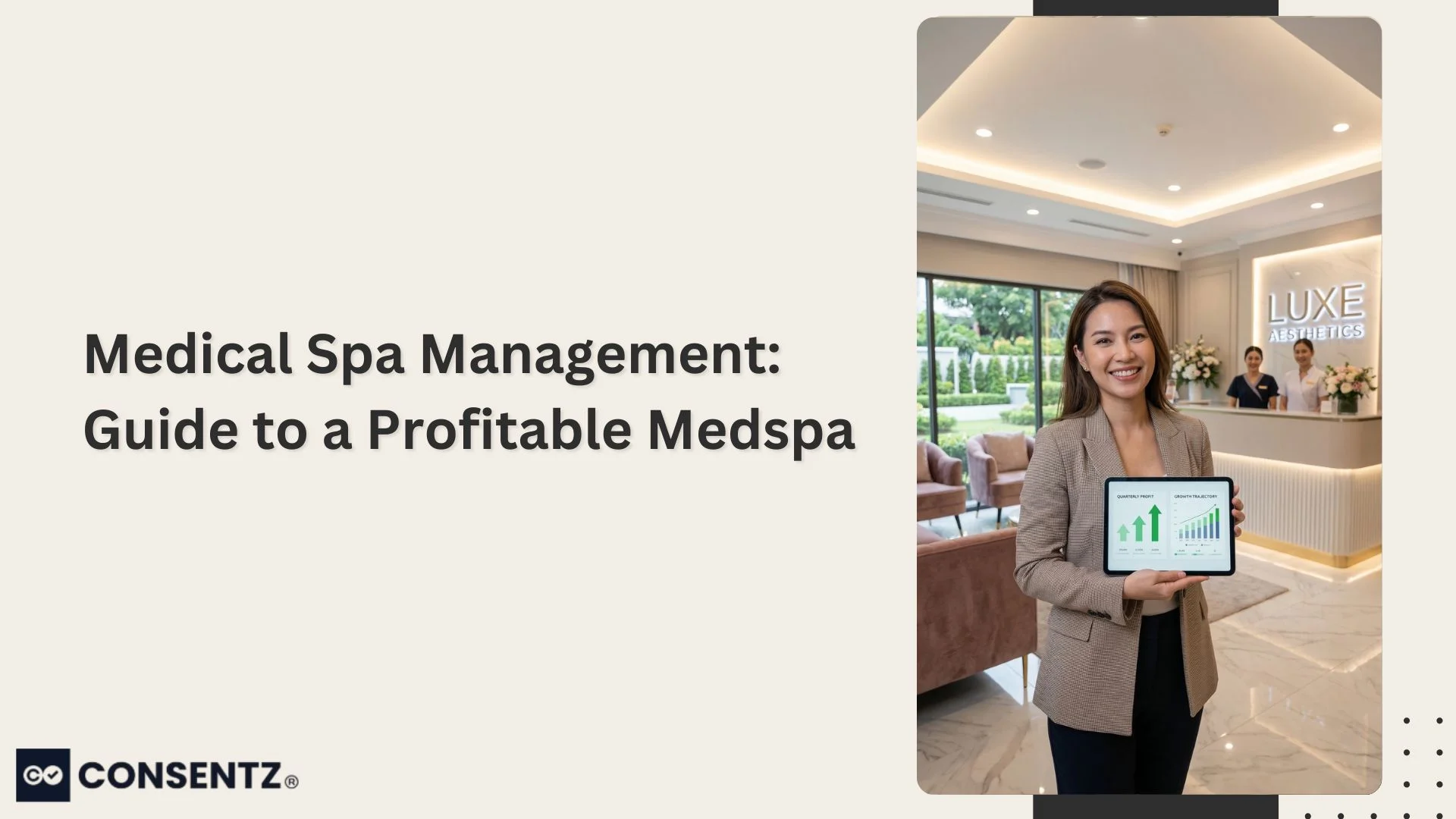
The medspa market reached USD 7.36 billion in 2024 and is projected to grow at 14% CAGR through 2034. As competition among medspas intensifies, the difference between platforms that support genuine growth and those that just manage appointments is substantial. Whether you are starting a medspa or scaling one past its first location, the software decision is a strategic one.
Why medspa software is fundamentally different from spa software
The distinction is the clinical layer. A regular spa offers non-medical treatments — massages, facials, waxing. A medspa offers medical aesthetic treatments — injectables, laser, chemical peels, IV therapy — performed by or under the supervision of licensed medical professionals. That clinical layer creates compliance obligations that regular spa software was never built to address.
The critical differences:
- HIPAA compliance: any system handling patient health information must provide encrypted storage, role-based access, audit trails, and Business Associate Agreements. Most salon platforms do not.
- Clinical documentation (EMR): medical aesthetic treatments require treatment notes in a proper patient record, not just appointment history. A medspa EHR layer is required.
- Treatment-specific consent: each treatment has specific risks that must be documented per procedure, per appointment — not covered by a generic intake form.
- Injectable batch tracking: prescription-only medicines require traceability from receipt to patient administration. Salon software cannot do this.
The non-negotiables every medspa needs
HIPAA-compliant patient records
Not HIPAA-adjacent — actually compliant, with a signed Business Associate Agreement available from the software provider. Any HIPAA compliant medical spa software evaluation should start with the BAA question. If the vendor cannot provide one, the conversation ends there.
Treatment-specific digital consent with audit trail
Every treatment needs its own consent form covering the specific risks of that procedure. Sent pre-appointment, signed electronically, stored with an unalterable timestamp. The consent form for Botox is not the same as the consent form for laser resurfacing — a generic form for both is a legal and compliance liability.
Clinical photography
Before and after documentation serves both clinical and marketing purposes — but under HIPAA, patient photos are Protected Health Information. A phone camera roll or shared Google Drive is a HIPAA violation. Photos need to be stored in an encrypted system linked directly to the patient record, with separate written authorisation required before any marketing use.
Injectable stock and batch tracking
Every injectable used on a patient needs a batch number in the record. This is the requirement that makes a product recall manageable rather than catastrophic. Injectable batch tracking connects the delivery record to the treatment note to the patient — without that chain, responding to an MHRA or FDA recall in time is practically impossible.
Online booking with deposit collection at point of booking
US medspas have no-show rates of 10–20%. Online booking with automatic deposit collection — at the point of booking, not as a follow-up chase — is the most reliable structural fix. Patients who have paid are patients who show up. The approaches that reduce no-shows most consistently all start with a financial commitment at booking.
Bookings, consent forms, patient records, payments, marketing — Consentz is the aesthetic clinic software that puts it all in one place so you can focus on your patients, not paperwork.
The features that separate growing medspas from static ones
Built-in patient marketing and CRM
Medspas that grow year on year without proportionally rising marketing budgets retain and reactivate existing patients more effectively than they acquire new ones. Built-in patient recall campaigns (automated at treatment intervals), a visual prospect pipeline for managing enquiries, and post-appointment review requests are the tools that make this possible. Adding a separate email platform, a CRM tool, and a review management tool onto a basic booking system adds cost, creates data silos, and still does not give you the integrated view that a single platform provides.
Reporting dashboards that drive decisions
Revenue by treatment, by provider, rebooking rates, new versus returning patients, lapsed patient count, stock usage and wastage — a growing medspa runs on monthly reporting. Without it, decisions about pricing, staffing, and marketing spend are based on gut feel. The monthly clinic reporting checklist covers what to track and what good looks like across each category.
Multi-provider calendar with room management
A medspa with two or more providers needs a calendar system that manages provider availability and room availability simultaneously — preventing two providers booking the same treatment room at the same time. Role-based access (reception sees booking availability; providers see their clinical detail; owners see everything) is essential at this scale.
Membership and pre-paid course management
Medspas with membership programmes generate significantly higher patient lifetime values. Software that handles monthly subscription billing, tracks pre-paid course balances, and allocates treatments to specific providers makes membership operationally viable rather than a billing headache. For the aesthetic nurse practitioners and solo injectors who often form the clinical backbone of US medspas, the requirements overlap significantly with what clinic management software for aesthetic nurses needs to provide.
Growing beyond one location
Multi-location medspa management introduces four additional requirements: patient records accessible and consistent across all locations, separate reporting per location with aggregate across all, stock management per location with inter-location transfers recorded, and role-based access that prevents Location A staff seeing Location B patient records without authorisation.
For the broader strategic and operational picture of running and scaling a medspa, the complete step-by-step guide to opening a med spa covers everything from initial licensing through to operational systems — including the what licence you need to open a medical spa state-by-state breakdown.
Frequently asked questions
1. What is the difference between medspa software and regular spa software?
The clinical layer. Regular spa software manages appointments and retail for non-medical services. Medspa software must also handle HIPAA-compliant patient health records, clinical documentation (EMR), treatment-specific digital consent, injectable batch tracking, and prescribing records. Without those features, a medspa using regular spa software has a compliance gap that a HIPAA audit, a product recall, or a patient complaint will expose.
2. Do medspas need HIPAA-compliant software even for non-clinical treatments?
If your medspa electronically stores or transmits any patient health information — including intake forms asking about allergies or medical history — HIPAA almost certainly applies. The threshold is lower than most medspa owners assume. The safe approach is to treat all patient data as HIPAA-covered, use software that provides a BAA, and operate as though a compliance review is always possible.
3. What features separate a basic booking tool from proper medspa software?
HIPAA-compliant patient records, treatment-specific digital consent with e-signature and audit trail, clinical photography with encrypted HIPAA-compliant storage, injectable batch tracking linked to patient records, and built-in marketing tools for patient retention. A booking tool manages appointments. A medspa management platform manages the full patient relationship from first enquiry to long-term retention, with compliance built throughout.
4. Can one system handle both the clinical and the business side?
Yes — and this is the defining advantage of purpose-built medspa software over connecting separate tools. Consentz provides bookings, HIPAA-compliant EMR, consent management, clinical photography, injectable stock tracking, billing (with Xero and Stripe integrations), marketing campaigns, and reporting in one platform. Patient data flows from booking to checkout without re-entry, every team member sees the same patient record, and you are not managing five subscriptions and five integration points.