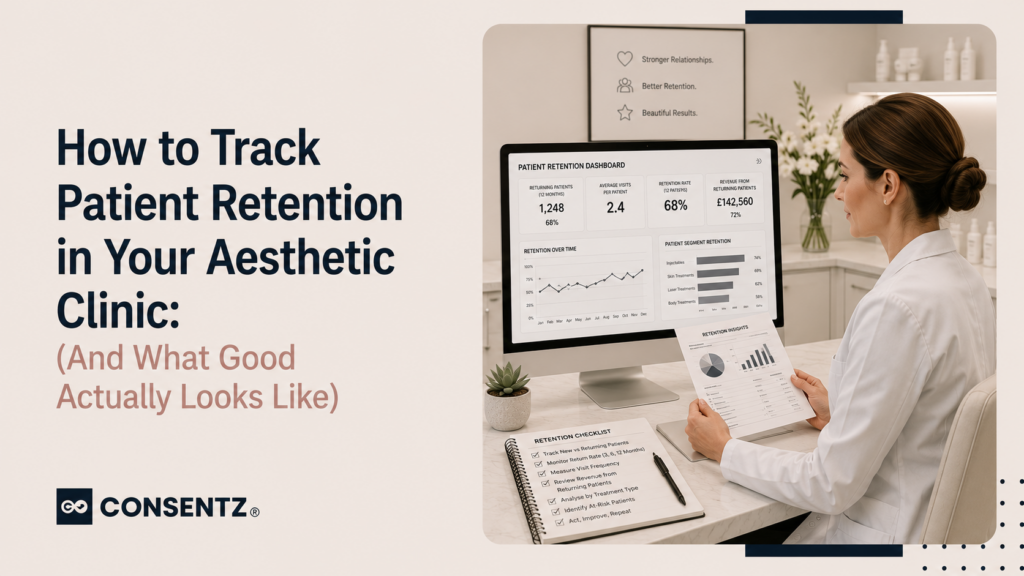
Most aesthetic clinic owners know their retention could be better. Patients come in, get a good result, and then drift — not because they were unhappy, but because nobody reached out when the treatment interval came around. The intent to return was there; the system to convert that intent into a booking was not.
Before you can improve patient retention, you need to measure it. And measurement turns out to be more nuanced than most clinic owners expect — there is not one retention metric, there are several, and each one diagnoses a different part of the problem.
The three retention metrics that matter
1. Rebooking rate
The percentage of patients who book their next appointment within seven days of their current one. This is the most immediate retention indicator — a patient who rebooks before leaving is far more likely to return than one who leaves with vague intentions to call later.
Formula: (patients who rebooked within 7 days ÷ total appointments in the period) × 100
Target: 50–60% or higher. Below 40% consistently suggests the checkout process is not systematically creating the next appointment. Above 70% is excellent and typically indicates that practitioners are recommending the next treatment during the consultation — before the patient has mentally left the building.
2. Return rate at 90 days
The percentage of patients from a given month who returned within 90 days — capturing patients who did not rebook immediately but still came back within the typical Botox treatment cycle.
Formula: (patients from month X who returned within 90 days ÷ total patients in month X) × 100
Target: 60–70% or higher for injectable-led practices. Below 50% at 90 days suggests patients are lapsing to competitors or simply not returning — and a re-engagement sequence needs to be running to catch them before they disappear entirely.
3. Lapsed patient trend
A lapsed patient is someone who has not returned in longer than their expected treatment interval. Track the number monthly and whether it is rising or falling. A falling lapsed count means more patients are returning on schedule than new patients are drifting. A rising count is the clearest early signal that retention is deteriorating — earlier than revenue, and much earlier than an actual patient complaints problem.
Bookings, consent forms, patient records, payments, marketing — Consentz is the aesthetic clinic software that puts it all in one place so you can focus on your patients, not paperwork.
Why you need to track retention by treatment type
Aggregate numbers hide specific problems. A clinic with strong Botox retention and weak skin treatment retention has an overall rate that looks acceptable — but is missing a significant issue in one service line.
- Injectables (Botox, lip filler, cheek filler): expected return within 10–24 weeks. Patients not back within 16 weeks for Botox are drifting.
- Skin treatments (peels, microneedling): expected return within 4–12 weeks. Course completion rate matters as much as rebooking — did patients who started a 3-session course return for all 3?
- Laser treatments: track protocol completion rate separately, then retention after course completion.
When treatment-level retention data is visible, patterns emerge. Good Botox retention but weak skin treatment retention tells you something specific — about how those consultations end, how recall messaging is written, or whether patient expectations for that treatment are being managed well.
Setting up monthly lapsed-patient filters
The most actionable use of retention tracking is identifying at-risk patients in time to reach them before they go cold. The practical filters to run at the start of each month:
- 10–14 weeks since Botox appointment: early recall window — patients in this group are deciding whether to rebook
- 6–9 months since filler appointment: dermal filler recall window
- 8–12 weeks since skin treatment: course patients or maintenance patients
- 90+ days, any treatment: general lapsed list — anyone overdue for any return visit
Run each filter, send targeted messages to each segment, and track the percentage that books within 14 days. The patient recall campaign structure — three messages over two weeks per segment — is the implementation of this tracking in practice.
What actually moves retention numbers
- Systematic rebooking at checkout: the practitioner recommends next treatment; front desk books it before the patient leaves. This single change typically moves rebooking rates 15–20 points.
- Automated recall sequences: patients who receive a timely, personalised recall message rebook at 70–80%. Patients who receive nothing rebook at far lower rates.
- No-show follow-up: a patient who no-shows and is not followed up within 24 hours effectively becomes a lapsed patient. Converting a no-show to a rebooking is a retention recovery action, not just diary management.
- Pipeline quality: patients who came through a proper enquiry-to-consultation process have significantly higher first-to-second appointment conversion than patients who booked through a discount promotion.
What does not move retention on its own: seasonal discounts and promotions. These increase booking volume temporarily but do not fix the underlying return rate. They attract new patients and win back deeply lapsed ones, but a clinic that relies on promotions to fill its diary has a retention problem it is masking rather than solving.
How to run this in Consentz
The reports dashboard shows rebooking rates, new versus returning splits, and appointment utilisation by month. The campaign manager lets you filter patients by last visit date and treatment type — so each monthly at-risk filter produces a list ready to receive a targeted message. For the full reporting picture across revenue, stock, and marketing alongside retention, the monthly clinic reporting checklist covers all five categories together. And for filling diary gaps between treatment cycles, the waiting list module catches late cancellations before they become revenue losses.
Frequently asked questions
1. What is a good rebooking rate for an aesthetic clinic?
50–60% within seven days is a solid benchmark. Clinics with a systematic checkout process consistently reach 65–75%. The lever that moves it most reliably is the practitioner recommending the next treatment during the consultation itself — not at checkout, and not by leaving it to the front desk to raise. Track it monthly and aim for incremental improvement: a 5-point gain over six months has a meaningful compounding effect on annual revenue.
2. How do I know which treatments have the best patient retention?
Filter your patient list by treatment type and calculate the 90-day return rate separately for each. In Consentz, the reporting tools segment by treatment type so you can compare retention across your service menu. If injectables retain well but skin treatments do not, that tells you something specific about how those consultations end or how the follow-up is written.
3. What makes patients not come back after a first treatment?
The most common reasons: the result was not what they expected (an expectations problem during consultation), nobody reached out when the treatment interval came around (a recall failure), or something in the patient experience created friction — difficulty rebooking, an impersonal checkout, aftercare that felt like an afterthought. The first two are process failures with clear fixes. The third is a patient experience issue that requires a different kind of attention.
4. Is a loyalty programme worth it for an aesthetic clinic?
When the loyalty mechanic creates a genuine reason to return rather than just discounting repeat visits. The most effective versions are treatment-interval memberships (a monthly fee covering a maintenance appointment plus perks), referral credit schemes (both the referring and referred patient receive value), and tiered access benefits for patients who attend regularly. Generic point-collection schemes that have no clear redemption value tend to be forgotten and create admin without changing behaviour.