Thinking about starting a career in aesthetics in the Hoosier State? To meet the core aesthetic license requirements in Indiana, prospective estheticians must be at least 18 years old, complete 700 hours of training, pass a state-administered exam, and pay a $40 application fee. Whether you dream of working as a practitioner, opening your own skincare salon, or launching a medical spa, understanding these rules is your first and most important step. If launching a med spa is your goal, start with this step-by-step guide to opening a med spa.
This guide breaks down the essential aesthetic license requirements in Indiana in a simple, easy to follow way. We’ll cover everything from your initial training to the complex rules for medical spas, so you can build your business with confidence.
Becoming a Licensed Esthetician in Indiana
Getting your individual esthetician license is the foundation of your career. Here’s a look at the core aesthetic license requirements in Indiana for practitioners.
Age and Education Prerequisites
Before you can even enroll in a beauty program, you need to meet a couple of basic benchmarks. In Indiana, you must be at least 18 years old to qualify for an esthetician license. You also need to have completed at least a 10th grade education or its equivalent, like a GED. This ensures you have the foundational knowledge to succeed in your professional training.
Training Hours and Exams
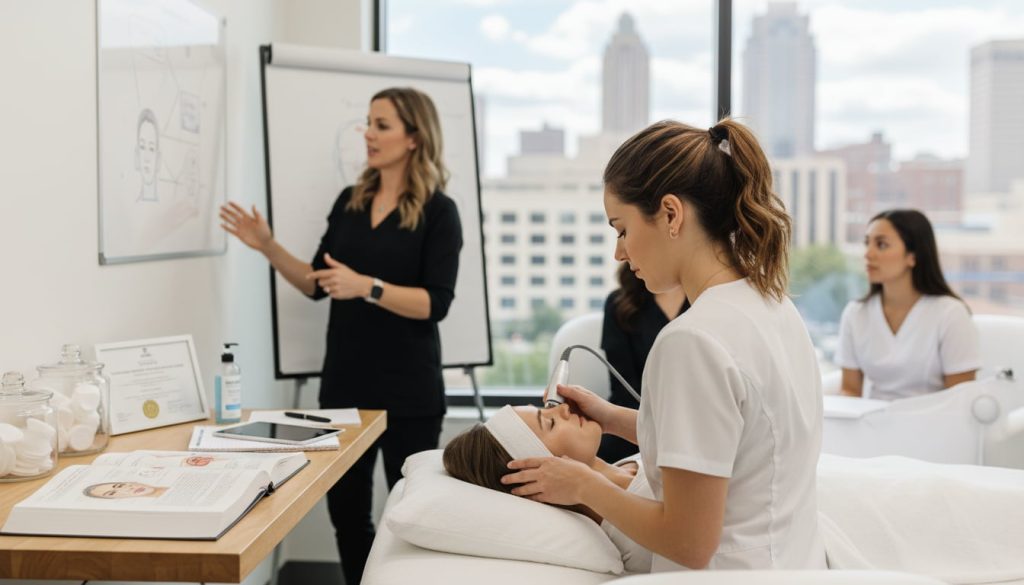
This is where your journey truly begins. The state requires you to complete 700 hours of training at an approved esthetics school. This program will cover theory, from skin anatomy to sanitation, and give you plenty of hands on practice with services like facials, waxing, and makeup application. A full time program usually takes about six months to complete.
Once you’ve logged your 700 hours, you must pass the state licensing examination. This is a written (theory) exam administered by a third party testing service (PSI) that verifies your knowledge of skincare, safety protocols, and Indiana law. Passing this exam is the final hurdle to earning your license.
Application Fees, Renewals, and Continuing Education
After passing your exam, you’ll submit an application to the Indiana Professional Licensing Agency. The application fee is a modest $40. Once issued, your Indiana esthetician license is valid for four years, which is longer than in many other states.
What about staying current? Here’s some good news: Indiana does not require continuing education (CE) hours for estheticians to renew their license. While you don’t have to take classes to stay licensed, pursuing advanced training is always a great way to grow your skills and stay competitive. When it’s time to renew, you’ll simply submit the renewal form and a $40 fee every four years.
Who Is in Charge? The State Licensing Board
The governing body that sets all these rules is the Indiana State Board of Cosmetology and Barber Examiners. This board operates under the Professional Licensing Agency and oversees all beauty culture professionals in the state. They approve schools, issue licenses, and handle disciplinary actions, making them the ultimate authority on aesthetic license requirements in Indiana.
Opening Your Own Esthetician Salon
Ready to be your own boss? Opening a salon or spa involves a separate set of requirements beyond your personal license. Here’s what you need to know about getting a Beauty Culture Salon license. If you’re weighing a medical spa build‑out, see how much it costs to open a med spa.
Salon License Qualifications
To get your shop licensed, you must meet several key criteria. You can’t just open up anywhere; the state has specific rules for your facility and operations.
- Proper Location: Your salon must be in a dedicated space. If it’s in your home, it needs to be separated from your living quarters by a floor to ceiling partition and have its own private entrance.
- Permits and Compliance: You’ll need to secure all necessary local building permits and pass any required inspections to ensure your space is up to code.
- Required Equipment: The salon must be fully equipped with professional chairs, tables, proper lighting, and sanitation stations, including a sink with hot and cold running water. You must be ready for business before you apply. To manage bookings across rooms and staff from day one, consider clinic scheduling software for aesthetics.
- Licensed Supervision: The salon must always be under the direct supervision of a licensed beauty professional (like an esthetician or cosmetologist). While the law doesn’t specify an experience level, having at least six months of professional experience is a common benchmark for someone taking on this role.
Temporary Permits and Signage Rules
Indiana offers a temporary salon permit that is valid for 90 days. This allows you to open your doors and start serving clients while your final application and inspection are being processed.
You must also follow signage rules. State law requires you to display a sign at the main public entrance that clearly identifies your business as a licensed beauty culture salon. Additionally, every licensed professional working in the salon must post their individual license at their workstation.
Waivers and Booth Rental Exemptions
What if you run into an emergency? The Board can consider granting a waiver for hardship on a case by case basis, but this is reserved for truly extraordinary circumstances.
If you’re not ready to open your own place, renting a booth is a popular option. The good news is that if you lease space inside an already licensed salon, you generally do not need a separate salon license for your room or station. The main salon’s license covers the entire premises, simplifying the process for independent contractors.
Navigating Medical Spa Regulations in Indiana
Medical spas operate under a stricter set of rules because they offer medical treatments. Understanding these specific aesthetic license requirements in Indiana is crucial for compliance and patient safety.
Who Can Own a Med Spa?
Due to the Corporate Practice of Medicine doctrine, a medical spa in Indiana must be owned by a licensed physician or a physician owned professional group. For a broader checklist on entity types and ownership models, see what license you need to open a medical spa. An esthetician or entrepreneur cannot own the medical practice and hire a doctor to simply act as a director.
However, non physicians can participate through a Management Services Organization (MSO) structure. In this model, the physician owns the clinical practice, while a separate MSO (which can be owned by anyone) handles the business operations like marketing, billing, and equipment leasing for a fee. This is a legally sound way to structure a partnership.
The Role of the Medical Director
Every med spa needs a designated licensed physician to serve as its Medical Director. This physician is responsible for overseeing all medical treatments, establishing safety protocols, and supervising the clinical staff, including PAs and NPs. They are ultimately accountable for patient care.
Facility Licensing and Who Can Perform Procedures
Unlike hospitals, med spas in Indiana generally do not need a special facility license from the Department of Health. However, they are still subject to health and safety inspections.
The most critical rule involves who can perform certain treatments.
- Injectables and Lasers: Procedures like Botox, dermal fillers, and laser treatments are considered the practice of medicine. In Indiana, these can only be performed by a physician, Physician Assistant (PA), or Advanced Practice Registered Nurse (APRN).
- Delegation: A physician may delegate these tasks to a Registered Nurse (RN) under their direct supervision and after establishing a treatment plan for the patient. Estheticians and cosmetologists are strictly prohibited from performing these medical procedures.
Supervision Rules for PAs and NPs
PAs and APRNs are key providers in many med spas, but they must work under physician oversight. A PA needs a supervisory agreement with a physician who is readily available for consultation. An APRN (like a Nurse Practitioner) needs a collaborative practice agreement with a physician to prescribe medications and perform certain medical acts.
Critical Compliance: OSHA, HIPAA, and Sanitation
Operating a med spa means juggling multiple compliance standards.
- OSHA: You must follow workplace safety rules, including the Bloodborne Pathogens Standard, which requires an exposure control plan, proper sharps disposal, and staff training.
- HIPAA: As a healthcare provider, you must protect patient health information. This means secure record keeping, providing privacy notices, and getting consent before sharing photos. Managing this documentation is a huge task, and many modern clinics rely on HIPAA‑compliant medical spa software to streamline consent forms and patient records.
- Sanitation: You must follow both medical grade sterilization protocols and the state cosmetology board’s sanitation rules for any aesthetic services offered.
Marketing Your Med Spa Legally
All advertising must be truthful and not misleading. You cannot guarantee results or make false claims. It is also critical to clearly state the credentials of the professionals performing services and avoid downplaying risks. For compliant patient acquisition tactics, see our guide to Facebook ads for aesthetics clinics. Using proper titles (MD, NP, PA, etc.) is mandatory.
Do You Need Malpractice Insurance?
While not always mandated by law, malpractice insurance is a practical necessity. All medical providers in the spa should be covered to protect against liability from potential complications. For physicians participating in Indiana’s Medical Malpractice Act, carrying minimum coverage levels is required. Strong documentation is your best defense in any claim, which is why having an organized, tamper proof system for notes and photos is invaluable. A tool like an electronic patient record system with an unalterable audit trail can be a lifesaver.
Navigating the full scope of aesthetic license requirements in Indiana can feel complex, but breaking it down step by step makes it manageable. By staying informed and compliant, you can build a safe, successful, and reputable aesthetics practice.
Frequently Asked Questions
What are the basic aesthetic license requirements in Indiana?
To get an esthetician license, you must be at least 18, have a 10th grade education or GED, complete 700 hours of training from an approved school, and pass the state’s written licensing exam.
How many hours do you need for an esthetician license in Indiana?
You are required to complete 700 hours of formal training at a state approved esthetics or cosmetology school.
Can an esthetician perform laser hair removal in Indiana?
No. Laser and energy based device treatments, including laser hair removal, are considered the practice of medicine in Indiana and can only be performed by or under the direct supervision of a licensed physician.
How often do I need to renew my Indiana esthetician license?
You must renew your esthetician license every four years. Indiana does not require any continuing education credits for renewal.
Who can own a medical spa in Indiana?
Due to the Corporate Practice of Medicine doctrine, a medical spa must be owned by a licensed physician or a physician owned entity. Non physicians can partner with doctors through a Management Services Organization (MSO) structure.
Do I need my own salon license to rent a booth in Indiana?
Generally, no. If you are an independent contractor renting a room or station inside an existing, licensed salon, you do not need to get a separate salon license for your space. You only need to maintain your personal esthetician license.