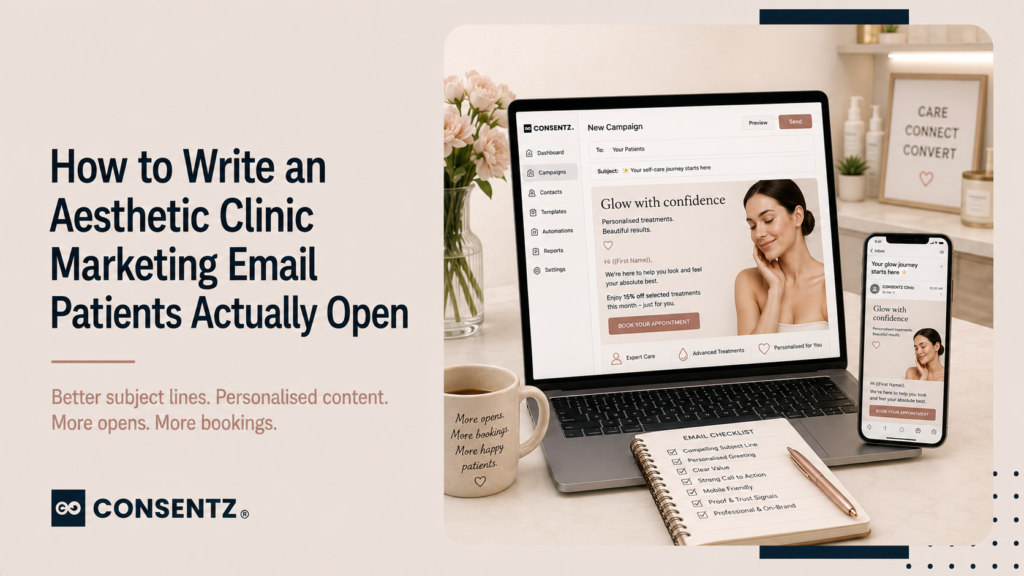
Most aesthetic clinic marketing emails fail before they are even read. Not because the content is poor — although it often is — but because the subject line does not give the patient a reason to open them. Clinic owners spend an hour writing a beautiful email and thirty seconds on the subject line. The subject line is the only thing that determines whether the email gets read.
This guide covers how to write clinic emails that patients actually open, read, and act on — from the subject line through to the specific type of email that drives bookings vs the type that just maintains brand awareness. For the strategic layer — how often to send, how to segment, and how to track results — the email marketing guide for aesthetic clinics covers all of that in full.
The four types of clinic email and what each one should do
Not all clinic emails have the same goal, and trying to make one email do everything is why so many clinic newsletters get ignored. Identify which type you are writing before you start:
- Recall email: sent when a patient’s treatment interval is due. Goal: get them to book. Short, direct, personalised to treatment type. This is the highest-converting clinic email — automate it by treatment and timing and it runs itself.
- Educational email: explains a treatment, addresses an objection, answers a FAQ. Goal: move a curious patient toward a consultation. Longer, more detailed, lower urgency.
- New treatment or launch email: announces something new. Goal: generate enquiries from existing patients. Needs a waiting list or booking link, a clear next step.
- Seasonal or event email: ties a treatment to a time of year. Goal: create relevance and urgency. Needs a specific angle that your specific audience cares about.
The mistake most clinics make is writing one generic email that tries to be all four — a newsletter that mentions the new treatment, includes an educational paragraph, has a seasonal offer, and ends with a booking link. Patients read none of it because none of it is specifically about them.
Subject lines — the only thing that actually determines open rate
Open rates in segmented aesthetic clinic email campaigns average 25–35% for well-written lists. The subject line accounts for almost all of the variation between campaigns that hit that range and ones that sit at 12%.
Subject line formulas that work for aesthetic clinics
- Personalised + timing: ‘[First name], your Botox appointment was 10 weeks ago’ — this outperforms seasonal subjects consistently because it is specifically relevant to this person at this moment
- Specific question: ‘How long does lip filler actually last?’ — creates curiosity by promising a specific, useful answer
- Before/after tension: ‘The one mistake people make before getting filler’ — specific, a little provocative, relevant to people considering the treatment
- Number + benefit: ‘3 things to know before your first Botox appointment’ — sets a clear expectation of what they will get
- Direct recall: ‘It has been a while — your skin might be ready for a refresh’ — works for lapsed patients because it is warm and non-pressuring
What kills open rates
- The word ‘newsletter’ in the subject line — signals low personal relevance
- All-caps or excessive punctuation — spam signals
- Generic seasonal subjects: ‘Spring offers at [Clinic Name]’ is the most-deleted subject in aesthetic clinic email
- Vague teasers — people are not curious enough to open for this
Bookings, consent forms, patient records, payments, marketing — Consentz is the aesthetic clinic software that puts it all in one place so you can focus on your patients, not paperwork.
Structure: what goes inside the email
Keep it short unless you have a specific reason to go long
Recall emails should be four to six lines. The patient knows your clinic, they know the treatment — they just need to be reminded and given a booking link. Educational emails can be longer because the patient is in a reading mode. But always write the email from the patient’s perspective: what does this patient need to know, and what is the one thing you want them to do after reading?
One email, one ask
Every clinic email should have one clear call to action. Not three. Not a booking link, a review link, and a ‘follow us on Instagram’ button in the same email. One ask performed consistently outperforms multiple asks in clinic email — partly because it is clearer, and partly because it forces you to decide what the email is actually for before you send it.
The opening line matters more than the rest of the body
The preview text — the line that appears in the inbox alongside the subject line — is usually the first sentence of the email. If that sentence is ‘Dear Patient, we hope you are well’, you have lost the reader before they open. Make the first sentence the most interesting line in the email.
- Weak opener: ‘Dear [First name], I hope this email finds you well. We are reaching out to let you know about…’
- Strong opener: ‘Your skin does a lot of work maintaining your Botox results — most patients find them starting to fade around now.’
Writing about seasonal treatments without sounding like every other clinic
‘Get summer-ready with our special offers!’ appears in thousands of clinic inboxes every spring. The alternative: find the specific, true thing about this season that matters to your specific patients.
Instead of: ‘Summer skin prep — 20% off peels this month’
Try: ‘If you’re planning a holiday, here’s the one treatment to avoid in the two weeks before you go — and what to book instead.’
The second version provides something useful. It acknowledges the patient’s situation. It does not lead with a discount. And it will drive more enquiries than the offer-led version, because it positions you as the expert rather than the promoter.
For the broader patient growth strategy that email fits into, and how your patient pipeline converts email engagement into bookings, both are worth reading alongside this guide.
Discounts in emails — when they help and when they hurt
Percentage discounts in clinic email work for one specific use case: winning back patients who have been gone 12 or more months and need a stronger nudge than a recall message alone can provide. For everyone else — active patients, recent visitors, patients in a normal treatment cycle — discounts train patients to wait for an offer before booking, and erode your pricing over time.
Effective alternatives to discounts:
- Added value: ‘Book your top-up this month and we’ll include a complimentary skin consultation’
- Urgency from genuine scarcity: ‘We have three appointment slots left before [Practitioner] is on holiday — these tend to go quickly’
- First access: ‘Existing patients get early access to our new LED facial before we open general booking next month’
These drive bookings without devaluing your services, and they keep patients engaged because the communication adds value rather than training them to wait for a discount.
Frequently asked questions
1. What subject line gets the most opens for aesthetic clinic emails?
Treatment-specific personalised subjects consistently outperform generic seasonal ones. For recall emails: ‘[First name], your Botox appointment was 10 weeks ago’ will outperform ‘Spring treatments at [Clinic Name]’ every time, because it is specifically relevant to this patient at this moment. For educational emails: specific question subjects (‘How long does lip filler last?’) outperform vague teasers. Always test two subject lines on a small segment before sending to your full list — a simple A/B test takes minutes and consistently reveals double-digit differences in open rate.
2. Should I use the patient’s first name in emails?
Yes — name personalisation in subject lines increases open rates by 10–15% on average. More importantly, use personalisation that goes beyond the name: referencing the patient’s specific treatment (‘your lip filler appointment’, ‘following your skin peel last month’) outperforms first-name-only personalisation because it signals that the email is genuinely about this patient, not a mail-merge to a list. Consentz’s email builder includes personalisation tokens for first name, last treatment type, and last appointment date.
3. How long should a clinic marketing email be?
As short as it needs to be to achieve its goal. For recall emails: four to six lines with a booking link. For educational emails: as long as the content genuinely requires — 200 words is typical, 400 is reasonable for a complex topic, 600+ should only be used if the email is genuinely acting as an article (in which case, consider whether a blog post with an email teaser would serve better). The length most clinics use — three paragraphs plus a list plus two CTAs plus a paragraph about following on social — is almost always too long.
4. What is a good offer to include in an email without cheapening the brand?
Added value rather than percentage discount. ‘Book your Botox top-up this month and include a complimentary skin assessment’ adds something without reducing the price. ‘First access to our new treatment before it opens to general booking’ adds exclusivity. ‘A free skin consultation for existing patients booking two or more treatments’ rewards loyalty. All three drive bookings, none of them trains patients to wait for a 20% off code before committing.
5. How do I write about seasonal treatments without sounding like every other clinic?
Find the specific, true insight about this season that matters to your specific patients — and write about that rather than the offer. The clinic writing ‘if you’re planning a summer holiday, here’s the one treatment that needs to be avoided in the 2 weeks before departure’ is providing something useful. The clinic writing ‘summer skin prep — 20% off peels this month’ is indistinguishable from the fifty other promotional emails that landed on the same day. Useful, specific content from the patient’s perspective consistently outperforms offer-led seasonal campaigns.