Most aesthetic practitioners start with what they know. A Calendly link for bookings, Google Forms for consent, a spreadsheet for patient records, and a WhatsApp group for the waiting list. It works well enough in the beginning — when patient volume is low, when most patients are personal referrals, and when a CQC inspection or insurance claim is something that happens to other people.
Then one of three things happens: the clinic grows, a patient complaint surfaces, or an insurance renewal requires evidence of clinical governance. At that point, the limitations of generic tools become visible very quickly. This guide covers exactly what general booking tools cannot do for an aesthetic clinic, why that matters clinically and legally, and what specialist clinic management software handles instead.
The five things general tools cannot do for an aesthetic clinic
1. Treatment-specific consent with a legal audit trail
A Google Form can collect a signature. It cannot: send the right consent form automatically based on the treatment booked, enforce a cooling-off period between information provision and treatment, store the consent with an unalterable timestamp linked to the specific patient and treatment, version-control the form so that if you update it, old signatures remain against the version that was current at the time, or produce the complete consent evidence pack that a CQC inspector or insurer asks for.
These are not technical limitations waiting for an update — they are fundamental architectural gaps. Google Forms is a survey tool. Digital consent for aesthetic clinics is a clinical records function. They require different systems.
2. HIPAA-compliant or CQC-compatible clinical records
A spreadsheet storing patient names, dates of birth, treatment notes, and health histories is processing special category data under UK GDPR. The same spreadsheet on an unencrypted laptop that gets stolen, left in a cafe, or shared with the wrong person is a data breach — with reporting obligations, potential ICO enforcement, and serious reputational consequences.
For US aesthetic clinics and medspas, HIPAA-compliant records require encrypted storage, role-based access controls, audit trails, and a Business Associate Agreement from every platform handling protected health information. A spreadsheet, cloud drive, or standard booking tool satisfies none of these requirements.
3. Injectable batch tracking from delivery to patient
When the MHRA issues a product recall, a clinic needs to identify within hours which patients were treated with the recalled batch. This requires a chain: the batch number recorded at goods received, deducted from stock when used, and linked to the patient’s treatment record.
Calendly records that a patient had an appointment. It does not record which batch of Bocouture was used. When a recall arrives, a clinic using generic tools faces a manual search through paper treatment notes across weeks of appointments. A clinic using batch tracking software runs a single query and has the complete patient list in seconds.
4. Automated patient recall by treatment interval
A spreadsheet can record that a patient had Botox on a specific date. It cannot automatically send that patient a personalised SMS at exactly 10 weeks, follow up with an email five days later if they have not responded, and close the sequence after a third touch. Automated recall campaigns built around treatment type and last visit date run continuously, for every patient, without any staff involvement.
For a clinic with 200 active patients, manual recall tracking requires a staff member to check a list and send messages. Automated recall means the right message goes to the right patient at the right time — every time — regardless of how busy the diary is.
5. Multi-practitioner room management and online booking
A Calendly link for each practitioner does not know that two practitioners share one treatment room. When both practitioners are busy, bookings arrive for both — potentially into the same room at the same time. Multi-practitioner calendar management that manages room allocation simultaneously with practitioner availability prevents this at the system level, not by relying on manual coordination.
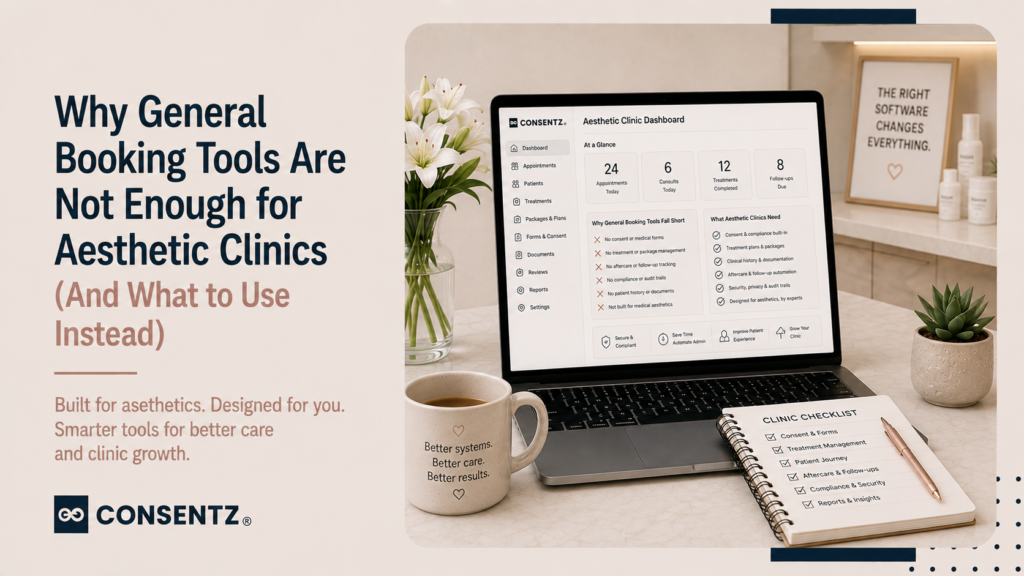
Bookings, consent forms, patient records, payments, marketing — Consentz is the aesthetic clinic software that puts it all in one place so you can focus on your patients, not paperwork.
The compliance risk of staying on a generic tool
This is not about CQC or HIPAA as abstract regulatory concepts. It is about what happens in practice when a patient complains about a treatment outcome, an insurer asks for evidence of clinical governance, or a product recall arrives:
- Complaint: the insurer asks to see the consent form and treatment notes for the appointment in question. If consent is in a Google Form response (with no record of when it was sent), treatment notes are in a spreadsheet, and photographs are on a personal iPhone — this evidence is difficult to produce, difficult to authenticate, and difficult to defend.
- Product recall: the MHRA issues a field safety notice for a batch of filler. You need to contact all affected patients within 48 hours. If the batch number is not recorded against each treatment, you have no list.
- CQC inspection: inspectors ask to see consent documentation, medicines management records, and evidence of complaints handling — all linked to patient records. A CQC inspection of a clinic using generic tools is significantly more challenging than one using a purpose-built system, because the evidence is not in one place.
These are not hypothetical scenarios. They are the situations that cause aesthetic clinics to fail CQC inspections, generate professional indemnity claims, and in serious cases result in MHRA or ICO action. The risk is not equally distributed — it lands disproportionately on clinics that have not invested in the systems that generate defensible documentation.
At what point does a clinic outgrow a generic tool?
The honest answer is that most aesthetic clinics outgrow a generic booking tool from the moment they start treating patients — because the compliance requirements apply from the first patient, not from the tenth or the hundredth. But in practice, the moments that most commonly trigger a migration:
- Receiving a first formal patient complaint and realising the evidence is scattered
- A professional indemnity insurance renewal with more detailed clinical governance questions
- Adding a second practitioner and discovering room booking conflicts
- Applying for or responding to a CQC inspection requirement
- A product recall notice arriving and not being able to quickly identify affected patients
All of these are reactive — the migration is prompted by a problem rather than by design. The proactive version is choosing specialist aesthetic clinic software before any of these events, so the documentation is already there when it is needed.
Frequently asked questions
1. Can I just use Calendly or Acuity for my aesthetic clinic?
For booking appointments, yes — Calendly and Acuity schedule appointments effectively. For running an aesthetic clinic compliantly, no. Neither platform provides treatment-specific consent with an audit trail, HIPAA or CQC-compatible clinical records, injectable batch tracking, treatment-interval recall automation, or multi-practitioner room management. They are scheduling tools used by thousands of different professions, and they cannot be adapted into a clinical records system. The result of using them for that purpose is a compliance gap that becomes visible at the worst possible time.
2. What does aesthetic-specific software do that a general booking tool cannot?
Aesthetic-specific software manages the clinical layer that general tools have no concept of: treatment-specific consent with version control and audit trails, clinical records linked to each appointment (not just booking history), injectable stock with batch tracking from goods received to patient administration, automated recall campaigns by treatment type and interval, and multi-practitioner room management. These are not add-ons to a booking system — they require a platform built with clinical workflows as the foundation, not added on top of a scheduling tool.
3. I use Google Forms for consent — what is wrong with that?
Google Forms collects responses, but it does not: send the specific consent form for the booked treatment automatically, enforce a cooling-off period, store the signed form against the patient record with an unalterable timestamp, version-control forms so that updated forms do not overwrite historical signatures, or produce an evidence pack for inspection. A Google Form response saved in a spreadsheet is not consent documentation that satisfies CQC standards or clinical indemnity insurance requirements. The form collects a tick — it does not create a legally defensible clinical record.
4. At what point does a clinic outgrow a basic booking system?
Strictly speaking, from the first patient — because the compliance requirements apply from the start, not from a particular patient volume. Practically speaking, most clinics feel the gap at the first formal complaint, the first insurance renewal with detailed governance questions, the first multi-practitioner conflict, or the first time a recall notice arrives and there are no batch records to search. The cost of migrating proactively is an onboarding process. The cost of migrating reactively is doing so while also managing whatever triggered the need.
5. What are the compliance risks of using a non-specialist system?
For UK clinics: non-compliant consent documentation (inadequate for CQC or professional indemnity), GDPR violations from storing special category patient data in unencrypted or inadequately controlled systems, and inability to produce evidence for a CQC inspection. For US clinics: HIPAA violations from storing PHI in systems without BAAs or appropriate encryption, with civil penalties of up to USD 50,000 per violation per year. For both: the inability to respond to a product recall within the required timescale, and the inability to produce contemporaneous documentation in the event of a patient complaint or claim.