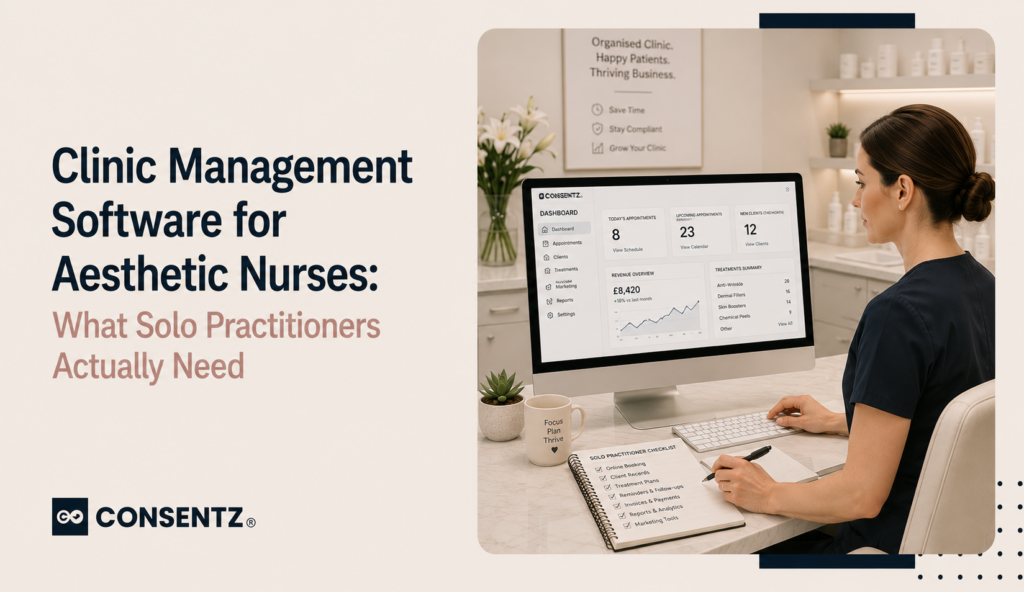
A solo aesthetic nurse has a fundamentally different relationship with clinic software than a multi-practitioner clinic. There is no front desk to manage bookings. No admin team to chase consent forms. No clinical manager to keep on top of injectable stock. Everything runs through one person — who also has patients to treat.
The result is that software which works fine for a larger clinic creates a different problem for a solo nurse: it is either too complex to use efficiently mid-clinic, or too basic to meet the compliance requirements that the NMC and MHRA now place on aesthetic practitioners — particularly around prescribing records and consent documentation.
This guide covers what aesthetic nurses actually need from clinic management software, where generic tools fall short, and what the minimum viable setup looks like for a nurse practising independently.
Why a generic booking tool is not enough
Calendly, Acuity, and similar scheduling tools handle appointments. They do not handle the clinical layer that NMC registration and MHRA compliance require from a prescribing aesthetic nurse:
- Treatment-specific consent forms: a Botox consent form and a filler consent form are different clinical documents. A scheduling tool has no concept of treatment-specific risk documentation.
- Cooling-off period compliance: no scheduling tool enforces or records the 24–48 hour gap between information provision and treatment. This is a CQC and NMC expectation.
- Prescribing records: your NMC prescribing record needs the patient, the product, the dose, and the batch number. This is not possible in a booking tool.
- GDPR-compliant clinical photography: before and after photos require separate consent from treatment consent, and need encrypted, role-based storage — not a personal iPhone camera roll.
- Injectable batch tracking: the MHRA requires batch-level records linking each vial to the patient it was used on. Scheduling apps cannot do this.
The moment you start practising independently, you take on clinical documentation obligations that require clinical systems. Opening a medical spa as a nurse involves understanding this distinction early — the tools that support your career as a nurse are not the same tools that support your business as a clinic operator.
Bookings, consent forms, patient records, payments, marketing — Consentz is the aesthetic clinic software that puts it all in one place so you can focus on your patients, not paperwork.
What a solo aesthetic nurse actually needs from software
Treatment-specific digital consent
A separate consent form for every treatment you offer — Botox, lip filler, cheek filler, skin boosters, threads — each covering the specific risks of that procedure. Sent to the patient before the appointment (satisfying the cooling-off requirement), signed electronically, stored with a timestamp that cannot be altered. The types of consent an aesthetic clinic needs — treatment, photo, marketing — each require a separate document and a separate opt-in.
Online booking with deposit collection
As a solo nurse, you cannot take calls while you are in clinic. Online booking that patients can access any time, with automatic deposit collection and automatic consent form triggering for the booked treatment, means the pre-appointment workflow runs while you are treating other patients.
Clinical records with before and after photography
Every patient needs a record with their health history, treatment notes, products used with batch numbers, and before and after images linked to each appointment. Clinical photography needs to be stored securely under GDPR with separate photo consent — not on a personal iPhone or shared cloud drive.
Injectable stock and batch tracking
As an NMC prescriber handling POMs, batch-level traceability from receipt to patient administration is a MHRA requirement. This takes under a minute per appointment in a system that handles it natively. Without it, a product recall is a documentation crisis rather than a manageable process.
Prescribing records per session
Your NMC prescribing records need to be linked to your patient records, not stored in a separate notebook. Since June 2025, the face-to-face consultation date must be separately documented for every prescribing decision for cosmetic injectables — a field that needs to be in your clinical record, not just your memory.
Automated appointment reminders
A solo nurse cannot manually text every patient the night before their appointment. Automated SMS and email reminders — set once, running always — are the practical fix for high no-show rates without adding admin overhead.
Do I need CQC registration as a solo aesthetic nurse?
Not automatically — but the answer is more complicated than it used to be. CQC registration is currently required for regulated activities including thread lifts, IV therapy, and certain surgical procedures. Botox and fillers for cosmetic purposes do not currently require registration.
However, the regulatory direction is consistently toward more oversight. The CQC compliance documentation toolkit covers the standards that registered clinics are inspected against — and running to those standards now, regardless of registration requirement, means you are already inspection-ready if the scope of regulation expands to include your treatments.
What should it cost?
Purpose-built aesthetic clinic software starts from around £49 per month for a solo practitioner. That is typically lower than the combined cost of separate booking, consent, and records tools — and it removes the data silos created when patient information is split across multiple platforms. Solo practitioner software options cover the field if you want a comparison. For the broader CRM picture, the best CRM software for cosmetic clinics guide compares platforms across features and pricing.
For the career context — what it takes to set up as an independent nurse and what you need in place before your first patient — the guide to becoming an aesthetic nurse practitioner covers the training and regulatory pathway in detail.
Frequently asked questions
1. Is there affordable clinic software for a solo aesthetic nurse just starting out?
Yes. Consentz starts from £49 per month for a solo practitioner — a full platform covering consent management, online booking, patient records, clinical photography, injectable stock tracking, automated reminders, and marketing tools. The total is comparable to or lower than running separate tools for booking, consent, and records, and it removes the admin overhead of maintaining multiple subscriptions.
2. Do I need a full practice management system or will a simple booking tool do?
A simple booking tool is not sufficient if you are handling prescription-only medicines. Your NMC prescribing obligations — batch records linked to patient notes, face-to-face consultation documented since June 2025, treatment-specific consent with cooling-off periods — cannot be met by a scheduling app. The compliance gap between a booking tool and a clinical practice management system is the gap that a complaint, an insurance claim, or an NMC investigation will expose.
3. What is the minimum I need working from home?
Non-negotiables: treatment-specific digital consent with e-signature and audit trail, online booking with deposit collection and automated reminders, patient records linked to treatment notes and clinical photos, and batch tracking for injectables. Marketing and advanced reporting are valuable additions but can follow once the compliance foundations are in place.
4. Is Consentz suitable for nurses who are not yet CQC registered?
Yes. Consentz is used by both CQC-registered clinics and non-registered aesthetic practitioners. For non-registered nurses, the consent, records, and stock documentation systems provide the clinical governance standard that professional indemnity insurers and the NMC expect. If you later register with CQC, your documentation is already at the required standard — no system migration needed.