Thinking about a career in skincare in the Gem State? That’s fantastic. To meet the aesthetic license requirements in Idaho, you must first graduate from a state-approved esthetics program, pass both a written (theory) and a practical exam, and then formally apply to the state board for licensure. This process ensures you can practice safely, legally, and confidently, making it your most important first step.
Let’s break down the entire journey, from the classroom to opening your own spa, so you know exactly what to expect.
Step 1: Complete an Approved Esthetics Program
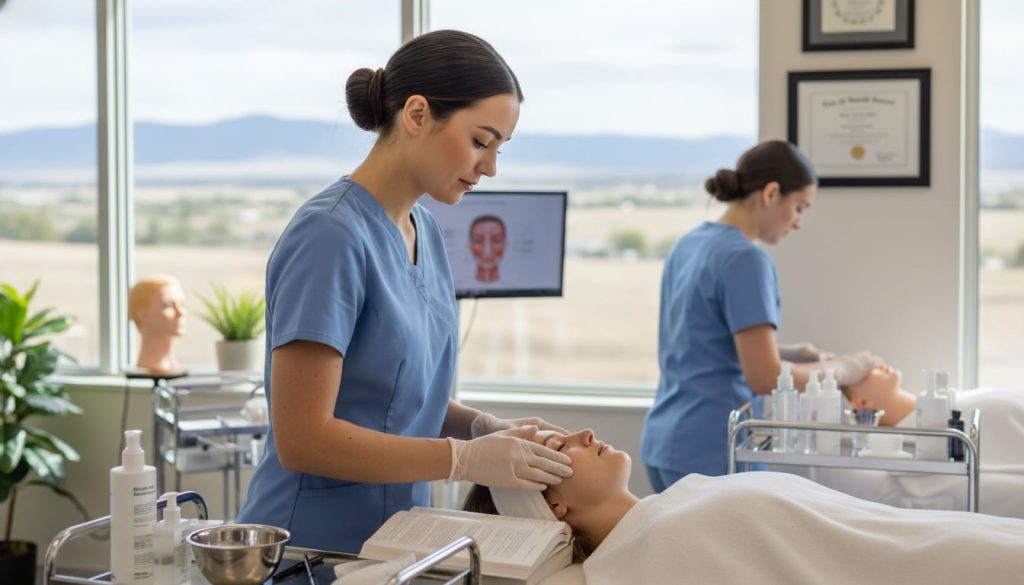
Your foundation in skincare begins with formal education. To qualify for a license in any state, you must graduate from a state approved esthetics program. This isn’t just a suggestion, it’s a mandatory step for public safety.
These programs are designed to give you the essential knowledge and hands on skills for your career. You’ll typically learn about:
- Skin anatomy and analysis
- Facial techniques and massage
- Hair removal methods like waxing
- Makeup application
- Crucially, sanitation and safety protocols
While training hour requirements vary a lot nationwide (from 220 hours in Florida to over 1,000 in Georgia), most states require somewhere between 600 and 750 hours of training. To enroll, you generally need to be at least 16 or 17 years old and have a high school education or equivalent. Depending on the schedule, you can expect to finish your program in about three to nine months.
Step 2: Pass the National Practical and Written Exams
Once you’ve graduated, it’s time to prove your skills. Most states, including Idaho, use the national exams developed by the National Interstate Council of State Boards of Cosmetology (NIC). This usually involves two separate tests:
- Written (Theory) Exam: This multiple choice test covers your textbook knowledge of skin science, anatomy, product chemistry, and safety regulations.
- Practical Exam: This is a hands on exam where you perform specific esthetic services on a mannequin in front of an evaluator. You’ll demonstrate tasks like cleansing a face, exfoliation, hair removal, and using equipment safely, just like you would in a real spa.
To schedule these exams, you’ll typically register with a third party testing company like Prov. This is a common step in the process where you’ll get a candidate information bulletin that details exactly what to bring and what to expect on test day. Most states require a passing score of 75% or higher on both exams.
Step 3: Apply for Your Idaho Esthetician License
With your education and exams complete, you can formally apply for your license. There are generally two ways to do this.
Licensure by Examination vs. Endorsement
- By Examination: This is the path for all new estheticians. You’ve completed your Idaho based training, passed the exams, and are applying for your very first license.
- By Endorsement (Reciprocity): This route is for estheticians who are already licensed in another state and are moving to Idaho. The Idaho state board will review your existing license and training to see if it meets their standards. If your original state’s requirements were equivalent, you may be able to get an Idaho license without retaking the exams.
Most states now have streamlined online portals to submit your application. You’ll create an account, upload your documents (like your school diploma and exam score report), and pay the application fee. This digital process is much faster than old paper applications and lets you get to work sooner.
Licensing Your Workspace: Establishment Requirements
Your personal license is just one piece of the puzzle. If you plan to open your own spa or salon room, the physical location also needs to be licensed. This is called an establishment license.
State boards require this to ensure your spa meets all health and safety standards, from proper sanitation stations to adequate ventilation. They will conduct inspections to verify compliance. If your business expands into a connected, or contiguous, space, it might be covered by your primary license. However, a separate, non contiguous location (like a second spa across town) will always require its own unique establishment license.
Managing a business involves keeping track of both your personal license and your establishment license. Using a purpose‑built platform like Consentz’s HIPAA-compliant medical spa software can help you keep all your business and compliance documents organized in one place, so you can focus on your clients. To keep your chair time full, adopt reminder workflows that reduce patient no-shows.
Staying Licensed: Renewal and Continuing Education
Your esthetician license doesn’t last forever. It needs to be renewed periodically to remain active. The most common renewal cycle for estheticians is every two years.
In many states, renewing your license also requires completing a certain number of continuing education (CE) hours. This ensures you stay current on industry best practices, new techniques, and safety updates. The CE requirements vary widely. Some states don’t require any, while others may mandate up to 16 hours every two years, often with specific courses on topics like infection control. Be sure to check the current aesthetic license requirements in Idaho for specific CE rules so you can renew your license without any delays. For a quick refresher on privacy and documentation standards often covered in CE, see the HIPAA requirements for a med spa.
Understanding Your Scope of Practice in Idaho
One of the most critical parts of being a licensed esthetician is knowing what you are legally allowed to do. This is called your scope of practice. Esthetics is defined as providing noninvasive skin care. This means you work exclusively on the epidermis, the outermost layers of the skin.
Your scope of practice generally includes:
- Facials, cleansing, and steaming
- Superficial exfoliation (including some mild chemical peels)
- Extractions of blemishes
- Makeup application
- Waxing and tweezing
Services that penetrate or affect the living layers of the skin (the dermis) are considered medical procedures and are outside your scope. This includes things like Botox injections, dermal fillers, and deep chemical peels. Performing services outside your legal scope can lead to serious penalties.
Using Skincare Devices: What the Aesthetic License Requirements in Idaho Allow
Modern esthetics involves a lot of technology. However, not all devices are created equal, and the aesthetic license requirements in Idaho are very specific about what you can use. The FDA classifies devices based on risk.
Class I Devices: The Everyday Tools
Class I devices are considered low risk. Think of tools like electric facial steamers, magnifying lamps, and high frequency wands. These devices are simple, noninvasive, and have a long history of safe use. As a licensed esthetician, you can typically use Class I devices without any special oversight.
Class II Devices: The Need for Medical Supervision
Class II devices carry a moderate risk and include more advanced technology like lasers, IPL machines, radiofrequency devices, and many microneedling pens. These tools often affect the skin on a deeper level.
Because of the increased risk, many states restrict their use. In fact, a 2018 Idaho law prohibits estheticians from using any Class II device (like certain types of LED therapy) without medical oversight. This is a crucial rule to remember. It means that to offer these advanced services in Idaho, you must work in a medical setting, such as a medspa, under the supervision and delegation of a licensed physician. If you’re planning to add physician oversight, review how much to pay a medical director for a med spa.
Compliance and Best Practices for Your Idaho Aesthetics Business
Operating a successful and legal practice goes beyond just having the right licenses. It’s about building trust and protecting both your clients and your business. Streamlining your billing and invoicing also protects revenue and reduces errors.
The Importance of Informed Consent
Before performing any service, especially an advanced one, you must obtain informed consent. This is a process where you explain the procedure, its benefits, potential risks, and alternatives to the client, who then signs a form agreeing to proceed. This is not just a formality, it’s a critical legal and ethical step that ensures your client is fully aware of the treatment.
For clinics offering advanced services with Class II devices, detailed and procedure specific consent forms are essential. Moving to digital forms with patient intake software for cosmetic clinics like Consentz can make this process seamless. It allows for secure e‑signatures, easy storage, and creates a clear audit trail for every client, strengthening your medico‑legal protection.
Avoiding Deceptive Titles and Statements
How you market yourself matters. State laws prohibit using deceptive titles or making false claims. A common mistake is using the title “Medical Esthetician.” Legally, this title does not exist, and using it can mislead the public into believing you have medical qualifications. Some states have even fined practitioners for using this term because it is a misrepresentation of licensure.
Always use your official title, such as “Licensed Esthetician.” Stick to honest and truthful statements about what your services can achieve. Building a great reputation is about providing excellent, ethical care, not about using flashy but inaccurate titles. Keeping your clinic’s operations organized with a smart management tool can free you up to focus on that quality care. Explore clinic operations software to simplify clinic management and help you stay compliant.
Frequently Asked Questions About Aesthetic License Requirements in Idaho
How many training hours do I need for an Idaho esthetician license?
While the national average is around 600 to 750 hours, you should always check with the Idaho Board of Cosmetology for the exact number of training hours required, as these regulations can be updated.
Can I use my esthetician license from another state in Idaho?
Yes, this is possible through a process called licensure by endorsement or reciprocity. Idaho’s licensing board will review your credentials to ensure your original state’s training and exam requirements are substantially equivalent to their own.
What’s the difference between an esthetician license and an establishment license in Idaho?
An esthetician license is a personal license for an individual to practice skincare. An establishment license is a separate license required for the physical location (the spa or salon) where those services are performed. You need both to operate your own business.
Can I perform laser hair removal with my basic esthetician license in Idaho?
No. Laser and IPL devices are considered Class II medical devices. Under Idaho law, an esthetician cannot operate these devices independently. You must work under the supervision of a licensed healthcare professional in a medical setting to perform such treatments.
Do I need continuing education to renew my license in Idaho?
Continuing education (CE) requirements vary by state and can change. It is essential to verify the current aesthetic license requirements in Idaho directly with the state board to see if CE hours are needed for your renewal cycle.