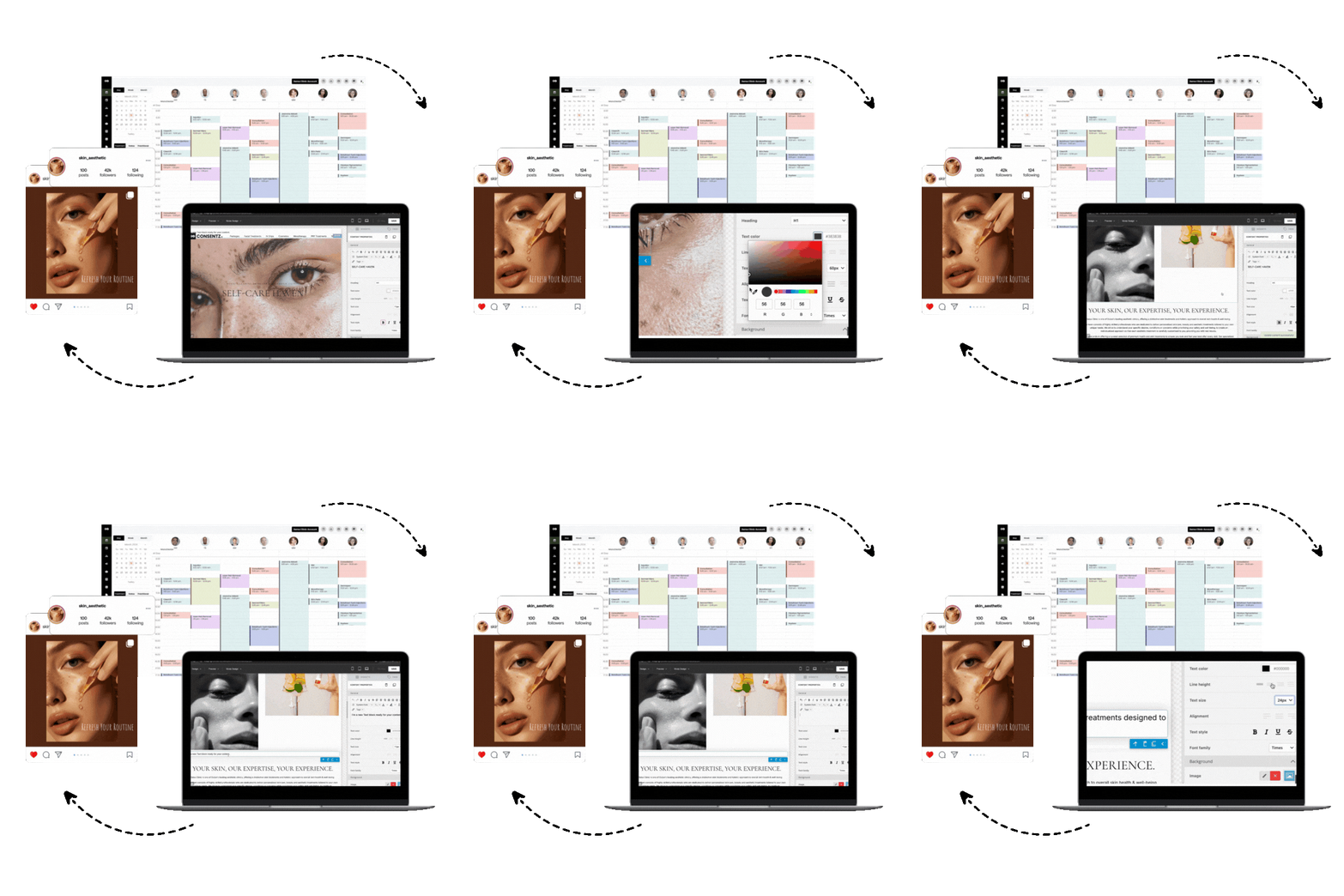
Empty chairs hurt cash flow, staff morale, and patient outcomes. The fastest way to reduce patient no-shows in aesthetic practices is to set a clear cancellation policy with deposits or a card on file, run two-touch multi-channel reminders with easy two-way replies, enable self-service rescheduling, and make a live day-before confirmation call while tracking no-show and late-cancel rates weekly. If you are asking How to reduce patient no-shows in aesthetic practices you are already on the right track. This guide shows what to measure, how to diagnose the real causes, and how to set up people and tech so attendance improves fast. Along the way you will see where an all in one platform like Consentz can help.
Define and measure what counts as a no show and how to track it
Start with a clear definition that everyone shares. A no show is a booked patient who does not arrive and does not cancel in advance within your stated cancellation window. Late cancellations are tracked separately so you can see different patterns and interventions.
What to measure weekly and monthly
No show rate, missed appointments divided by total booked
Late cancellation rate, cancelled inside policy window
Attendance rate by clinician, treatment type, day, and time
Lead time to appointment, days between booking and visit
Confirmation status, confirmed, not confirmed, rescheduled
Reminder performance, open rate for email and reply rate for SMS
Helpful facts you can use
Across healthcare, published studies report no show rates that often fall between 5 to 30 percent depending on specialty and location
SMS reminders consistently reduce missed appointments versus no reminder
Two touch reminders work better than one touch, for example 48 hours and same day
Allowing quick patient replies to confirm or reschedule improves attendance compared with one way reminders
Clear policies at booking reduce disputes and improve follow through
If you want a single source of truth for these metrics, the Consentz Control Centre shows real time KPIs and trends so you can track How to reduce patient no-shows in aesthetic practices with data, not guesswork. See the platform at Consentz.
Diagnose root causes in your clinic
Use your data and staff input to find patterns before jumping to tactics.
Common root causes to check
Communication gaps, patients did not see or understand reminders
Friction to reschedule, patients could not change time easily
Long lead times, the longer the wait, the higher the risk
Cost anxiety, unclear pricing or fear about deposits and charges
Transport or timing issues, parking, traffic, school runs
Treatment type, consults and low ticket services often have higher no show rates
First time patient risk, new patients often miss more than returning ones
Quick diagnostic moves
Review three months of data by day and slot time to spot risky windows
Ask front desk for the top three reasons patients give when rescheduling late
Audit reminder content for clarity and tone
Mystery book your own clinic to experience the process
The question How to reduce patient no-shows in aesthetic practices becomes easier once you see which root cause dominates.
Top 10 Ways to Reduce Patient No-Shows in Aesthetic Practices
Building on the reasons patients miss visits, this section brings together the most effective, aesthetics-specific tactics you can apply immediately. These 10 strategies are grouped to balance policy, payment, automation, and human touchpoints, so you can layer them into a cohesive system that protects revenue, stabilizes your schedule, and elevates the patient experience. Use them as a practical checklist to capture quick wins while setting up sustainable routines your team can maintain.
1. Implement a clear, written no-show/cancellation policy (transparent, with fees as appropriate)
Clear, fair rules turn polite intentions into kept appointments. A written policy, visible at every touchpoint, gives patients certainty and your team confidence to enforce, protecting chair time without sacrificing trust.
Clarity plus consistency beats last-minute apologies.
Why this reduces no-shows
In elective aesthetics, a clear, consistently enforced policy sets expectations at booking, adds a modest financial stake that discourages casual scheduling, and removes ambiguity for staff. Transparency and fair exceptions preserve trust, while predictable rules protect chair time and enable backfilling.
Put it into practice
Set notice windows: 24 hours for ≤45-min visits; 48 hours for >60-min/peak. Define deposits applied to treatment ($50 consult; $100 to $250 injectables/laser). Establish one-time courtesy waiver and illness exceptions (manager + medical director, EHR/PM).
Publish and capture consent at booking. Display in online booking, website, intake forms, and check-in; require a checkbox/initials (patient portal, EHR/PM). Front desk script: “To reserve, we take a deposit; late cancels/no-shows forfeit.”
Capture payment at scheduling. Secure card-on-file or collect deposits; send links for phone/email bookings (payment links, EHR/PM). Document forfeits/refunds; waitlist late cancels. Front desk verifies; manager adjudicates exceptions consistently.
Measure what matters
Track no-show %, late-cancel %, confirmation rate, and recovered revenue via waitlist/deposits. Target reducing no-shows to 3 to 5% and late-cancels to 5 to 7% within 4 to 8 weeks; backfill ≥50% of slots; capture fees on ≥90% eligible.
2. Offer prepaid appointments or require deposits/credit card on file
When money meets intent, commitment sticks. Applied deposits or prepaid bookings align patient motivation with the real value of limited, high-demand slots and they streamline checkout.
Small stakes now, fewer empty chairs later.
Why this reduces no-shows
Small, applied financial commitments align patient intent with the value of scarce aesthetic slots. Prepayment or a card on file reduces casual shopping, prompts rescheduling, shortens checkout, and fairly offsets late gaps, protecting provider time while preserving convenience and transparency for patients.
Put it into practice
Set policy and amounts (practice manager + medical director): Define deposit tiers by service, a 24 to 48 hour cancellation window, and consequences (retain deposit or fixed fee). Publish in confirmations and intake. Allow courtesy reschedule; verify compliance with regulations.
Configure tools (online booking, EHR/PM, patient portal, deposits/waitlist): Require prepayment or card-on-file to finalize; for phone bookings, send payment links and tokenize in the EHR/PM. Enable late-cancel/no-show fee triggers and connect the waitlist for released slots.
Automate reminders and follow-ups (SMS/email reminders): Send at 72 and 24 hours; front desk calls if unconfirmed by T-24, release to waitlist.
Measure what matters
Track no-show%, late-cancel%, confirmation rate, and recovered revenue via waitlist/fees; for deeper revenue workflows, see dermatology RCM software. Target reducing no-shows from 12% to under 6% and late-cancels to 3 to 5% within 60 to 90 days; iterate monthly based on exceptions and disputes trends.
3. Send automated reminders via multiple channels
Patients book weeks ahead and life shifts fast. Staggered reminders across SMS, email, and app push keep the appointment top of mind and make confirming or rescheduling frictionless.
Right message, right channel, right time.
Why this reduces no-shows
Aesthetic patients often book weeks ahead while juggling work, travel, and social plans. Staggered reminders via SMS, email, and app push reduce forgetfulness, prompt confirmations or reschedules, reinforce pre-care, and highlight provider time value, lowering no-shows and smoothing front-desk workload and experience.
Put it into practice
Set a reliable cadence: T-7 days email with pre-care and reschedule link; T-72 hours SMS+email with one-tap Confirm/Reschedule; T-24 hours SMS/app push with parking; T-2 hours concise SMS. Honor channel preference, auto-fallback on nondelivery, and respect quiet hours.
Make messages actionable: include Confirm/Reschedule/Cancel buttons (online booking), pre-visit forms/instructions (patient portal), brief treatment notes without PHI, and deposit/payment links when applicable. Script cue: “Hi there, you’re booked Tuesday at 3:30 PM with your provider. Reply C to confirm, R to reschedule.”
Define staff workflow: front desk monitors unconfirmed; coordinator handles questions; auto-release to waitlist (EHR/PM) patients.
Measure what matters
Track no-show %, late-cancel %, confirmation rate within 24 to 48 hours, and revenue recovered via waitlist. Aim to cut no-shows from 12% to 6% in 60 to 90 days, while confirming ≥92% and backfilling last-minute slots.
4. Call patients the day before their appointments
A quick, friendly call turns a date on a calendar into a promise. The human touch calms nerves, answers questions, and catches conflicts while there is still time to fill a spot.
A voice builds accountability that texts can’t match.
Why this reduces no-shows
A live day-before call activates commitment and consistency: when patients verbally confirm, they are far less likely to skip. In aesthetics, the human touch reduces anxiety, reinforces value, and clarifies prep. Operationally, early cancellations enable waitlist backfills and safeguard provider time significantly.
Put it into practice
Assign ownership and timing: front desk or patient care coordinator runs a next-day call list from the EHR/PM at 10 to 11 a.m.; second attempt 4 to 6 p.m.; call Friday for Monday; aim for two live attempts, then voicemail plus SMS/email reminders.
Use a concise script and capture a clear yes: confirm treatment, provider, date, time, location, and 24-hour cancellation policy; ask about health or medication changes; warm-transfer clinical questions to a nurse or injector; record Confirmed/Reschedule/At-risk in the EHR/PM.
Backstop and backfill: after two failed attempts, send SMS/email requiring reconfirmation; flag At-risk in EHR/PM; trigger waitlist/online booking.
Measure what matters
Track confirmation rate by 6:00 p.m., no-show percentage, and recovered-slot revenue via waitlist. Target ≥90 to 95% confirmations, ≤3 to 5% no-shows within 4 to 8 weeks, and ≥50% of day-before cancellations refilled; iterate scripts and cadence monthly continually.
5. Enable self-scheduling and rescheduling
When plans change, patients should not have to wait on hold. Self-service booking and rescheduling meet modern expectations and save your team from phone-tag.
Autonomy today prevents no-shows tomorrow.
Why this reduces no-shows
Giving patients 24/7 autonomy to book or move appointments removes friction when life shifts, reinforcing commitment and perceived access. Easy, policy-aligned rescheduling protects deposits and treatment plans, while real-time calendar updates expose openings that waitlists fill quickly, stabilizing productivity and revenue.
Put it into practice
Activate real-time online booking via EHR/PM: set types, durations, buffers, and provider rules; expose slots. Front desk verifies contacts, educates.
Embed self-reschedule in reminders: send SMS/email at 72 and 24 hours. Script: “Need another time? Tap to reschedule, no call needed.”
Align policy with deposits: take a deposit at booking; transfer when rescheduled before cutoff (24 to 48 hours). Use payment links and EHR/PM rules to enforce.
Auto-fill cancellations from a live waitlist: trigger prioritized SMS offers; send two waves 15 to 30 minutes apart, then release publicly. After a no-show, message a self-service rebook link within 30 to 60 minutes promptly.
Measure what matters
Track no-show %, late-cancel %, confirmation rate, and recovered-slot revenue via waitlist. Aim to cut no-shows from 12% to <6% within 60 to 90 days and fill 60 to 75% of vacated slots, with benchmarking and iteration.
6. Send appointment confirmations
The moment a booking is made, lock in the details. Immediate confirmations transform intent into a concrete plan and surface conflicts early, when they are easiest to fix.
Confirm fast, correct errors faster.
Why this reduces no-shows
Instant confirmations convert intent into commitment, clarify provider, time, and location, and deliver prep steps that build confidence for aesthetic visits. Expectations become explicit, conflicts surface early, and policies feel transparent, reducing no-shows while improving plan follow-through, photo readiness, and day-of efficiency.
Put it into practice
Trigger multi-channel confirmations within two minutes of booking via online booking or front desk using EHR/PM, SMS/email, calendar attachments.
Include a concise blueprint: date, time, provider, location/map, visit type, duration, prep notes, price, cancellation policy, patient portal intake.
Set a confirmation cadence: if unconfirmed after 24 hours, resend SMS/email; 48 to 72 hours pre-visit, escalate to live call contact.
Assign roles and scripts: front desk configures templates; coordinators monitor Unconfirmed twice daily; manager sets cutoff and releases slots.
Segment high-value blocks: require double confirmation and deposit; send day-of SMS; offer rescheduling via patient portal to reduce friction.
Measure what matters
Track confirmation rate at 24 and 48 hours, no-show %, late-cancel %, and recovered revenue via waitlist. Target 92 to 95% confirmations and reduce no-shows from 12% to under 6% within 60 to 90 days; iterate monthly.
7. Prioritize accessibility and answer every incoming call
If patients can reach you, they will reschedule instead of disappearing. A live answer signals hospitality and keeps momentum in an elective journey where timing is everything.
Be the practice that always picks up.
Why this reduces no-shows
In elective aesthetics, momentum matters. Live human answer signals value, resolves prep/aftercare questions, and rebooks instantly, preventing silent drop-off. Easy access lowers friction, preserves treatment-plan follow-through from consult photos to post-op checks, and reduces defection to “whoever answers first” elsewhere today.
Put it into practice
Adopt a three-ring rule during posted hours; cross-train front desk and a backup pool for peaks. Overflow to remote staff before voicemail. Triage: urgent post-procedure issues to a clinician; other calls handled by the patient coordinator.
Reschedule in one call: open the record (EHR/PM), offer earliest available or same provider, add to waitlist if needed, and send instant confirmation via SMS/email reminders. If deposits apply, text payment links before ending.
Cover missed/after-hours calls: return within 10 minutes in hours and 60 minutes after hours; log outcomes (EHR/PM). Voicemail invites text, online booking, and patient portal self-service.
Measure what matters
Track live-answer rate, reschedule capture, confirmation rate, and no-show/late-cancel %. Target ≥95% human answer, ≥70% reschedule conversion, and cut no-shows from baseline by 25 to 50% within 60 to 90 days; iterate using call audits and scorecards.
8. Adopt specialty-specific, flexible approaches
Different treatments create different barriers. Tailor scheduling, prep, and consent by modality to neutralize confusion and keep patients confident they are ready for the exact service they booked.
One size fits none: personalize the path.
Why this reduces no-shows
In aesthetics, modality-specific prep, downtime, and privacy concerns derail attendance. Tailoring scheduling, prep, and consent to injectables versus device treatments reduces uncertainty, strengthens commitment cues, and raises perceived value. Right-sized slots and rescheduling/conversion paths salvage at-risk visits and minimize last-minute friction.
Put it into practice
Segment by modality and right-size templates: Neurotoxin express 15 to 20, Filler new 45 to 60, Laser patch test 15, Resurfacing consult 30 to 45. In online booking, add disqualifiers; auto-offer consult-only. Build in EHR/PM; front desk verifies readiness at every booking.
Send modality-specific prep and consent: T-72h checklist, T-24h guidance, morning-of check-in. Deliver health history, area intake, photo consent via patient portal; nudge completion with SMS/email reminders. Include “Reply 1 confirm, 2 reschedule.”
Collect a credited $50 to $200 deposit via payment links; allow one free ≥48-hour reschedule; configure in EHR/PM. Reassure patients.
Convert unready visits; trigger waitlist; quick-fill; MA/lead nurse triages.
Measure what matters
Track no-show %, late-cancel %, confirmation rate, and recovered revenue via waitlist. Target reducing no-shows from 12% to under 6% and late-cancels to ≤5% within 60 to 90 days; iterate weekly by modality and template.
9. Remind patients of their next appointment
Aesthetic outcomes depend on series and maintenance. Proactive reminders keep patients on their photo-and-plan trajectory and make it effortless to confirm or move a visit.
Keep the plan visible and the calendar easy.
Why this reduces no-shows
Aesthetic plans rely on series and maintenance dosing. Timely reminders nudge commitment, reduce forgetfulness, and keep patients on their photo-and-plan trajectory. Clear, two-way messages that simplify confirming or rescheduling minimize gaps, protect chair time, and uphold value and continuity of care.
Put it into practice
Capture preferences at checkout: confirm channel/time and consent; store in the EHR/PM. Keep PHI minimal; reference “your appointment” and include opt-out language (SMS/email reminders).
Automate the cadence: instant confirmation with add-to-calendar; reminders at 7 days, 72 hours (policy snippet), 24 hours, and same-day at T-2 to 3h (SMS/email reminders, EHR/PM).
Enable two-way, self-serve options: one-tap Confirm, quick-reply codes, and self-reschedule links (online booking, patient portal). If deposits apply, add secure payment links in confirmations.
Escalate and backfill: unconfirmed by T-24h triggers promptly a front-desk call; released slots auto-offer to the waitlist and ping interested patients (EHR/PM, waitlist).
Measure what matters
Track no-show % and late-cancel %, plus T-48h confirmation rate and recovered-slot revenue via waitlist. Target reducing no-shows from ~12% to <6% within 60 to 90 days and achieving ≥90% confirmations by T-48h for procedures.
10. Tailor outreach for busy patients who forget or double-book
Your highest-value patients are often your busiest. Smart segmentation and concise nudges meet them where they are, on the go, while protecting your prime-time capacity.
Precision reminders for high-impact schedules.
Why this reduces no-shows
Time-pressed aesthetic patients often intend to attend but juggle multiple calendars, miss pings, or hold duplicate prime slots. Behavioral segmentation with short, well-timed nudges plus one-tap confirm/reschedule and calendar holds reduces friction, prompts micro-commitments, surfaces conflicts early, and preserves premium capacity.
Put it into practice
Identify and tag the segment (EHR/PM): flag 2+ reschedules in six months, confirmations, peak-hour bookings; capture channel (SMS/email), consent, response times.
Personalize cadence (SMS/email reminders, patient portal): send confirmation with add-to-calendar; schedule N-7 and N-3 reminders at times; include one-tap Confirm/Reschedule (online booking); coordinator reviews nonresponders. Script: Tap to pick another time.
Prevent double-booking (EHR/PM, online booking): auto-check overlaps ±7 days; block second holds at peak; escalate conflicts to coordinator within 12 hours.
Bounded flexibility (online booking, deposits/waitlist, payment links): surface alternatives; allow self-service changes ≥24 hours; require deposits for prime times; trigger waitlist notifications.
Measure what matters
Track no-show % for this segment, 72-hour confirmation rate, and waitlist fill for released peak slots. Target ≤7% no-shows and ≥85% confirmations in 60 to 90 days, with ≥70% backfill; iterate cadence and scripts monthly.
SOPs and team alignment to make it stick
Attendance improves when policies are simple, consistent, and visible.
What to standardize this week
Define confirmation protocol, when to send reminders and how staff handle non responses
Define the cancellation window and fees, communicate it at booking and in every reminder
Create a same day rescue playbook, waitlist text, call order, offer to move future patients forward
Use scripts for confirmation calls, friendly tone, clear ask, easy reschedule path
Post your policy on the website (see medical website templates), in emails, and at reception
Coach and reinforce
Brief the team in one stand up and role play common scenarios
Track two or three lead indicators, confirmation rate, deposits captured, waitlist fill rate
Celebrate weekly wins and share what worked
If you use Consentz, you can store SOPs in the built in Academy, lock permissions by role, and keep an audit trail of who changed what. That helps with inspections and provides a foundation for How to reduce patient no-shows in aesthetic practices across locations. Explore more at Consentz.
Build the right technology stack to support attendance
Your tools should make the right thing the easy thing. If you’re evaluating EHR/PM platforms, see our Dermatology EMR Software Buyer’s Guide.
Essential capabilities to look for
Automated SMS and email reminders with two way replies
One click patient confirmation that syncs to the diary
Easy reschedule links and call back options
Waitlist with instant notifications when slots open
Online deposits or card on file to reduce casual booking
Real time analytics on attendance, by clinician and treatment
Secure hosting and compliance posture suitable for healthcare
Where Consentz fits
The Consentz Medical App on iPad handles chairside tasks, intake, signatures, and billing initiation
The web based Control Centre manages schedules across rooms and clinicians, reminders via Twilio, payments through Stripe, and accounting sync with Xero
Dynamic waitlists and quick drag and drop changes help front desk fill gaps fast
Prepayments and bundles let you secure revenue and reduce no shows for treatment courses
Photos, consent forms, and treatment plans live in one place so patients arrive better prepared
Data is hosted on AWS with encryption in transit and at rest, ISO 27001 is referenced on the site
Using an integrated platform simplifies How to reduce patient no-shows in aesthetic practices because your diary, reminders, billing, and analytics work together. Book a quick look at Consentz.
What does not work and why
Weak tactics can waste time and frustrate patients.
Avoid these common missteps
One week only reminders, too early and easy to forget
Email only reminders for new patients, emails are missed more than texts
Complicated cancellation policies that staff cannot explain
Manual spreadsheets for waitlists, too slow to fill same day gaps
Hidden fees that appear at checkout, this erodes trust
Evidence based takeaways
Multi channel reminders outperform single channel communications for attendance
Short notice texts are more effective than far in advance emails
Clinics that collect a small deposit report lower no show rates than clinics that do not collect anything up front
Keep asking How to reduce patient no-shows in aesthetic practices in a way that respects patient experience and your brand.
Implementation and measurement a 90 day plan
Week 1 to 2, set the baseline and policies
Pull last 90 days of attendance data and set targets
Finalize your cancellation window and fees
Turn on two touch reminders, for example 48 hours and morning of appointment
Enable easy rescheduling links in every message
Week 3 to 6, activate the rescue system
Build a waitlist for each service and location
Write short templates for same day fill messages
Add deposits for high risk slots such as evenings and first time consults
Train the team on the rescue playbook
Week 7 to 10, optimize and personalize
Identify high risk cohorts such as first timers and long lead time bookings
Add an extra touch for these cohorts such as a friendly nurse message with pre-visit tips
Use analytics to move risky slots to times with better attendance
Week 11 to 13, review and lock in
Compare no show rate to baseline and share wins
Keep what worked, retire what did not
Document the SOPs in your staff handbook and in Consentz Academy, and review our clinical documentation improvement guide.
This plan keeps everyone aligned on How to reduce patient no-shows in aesthetic practices with a clear weekly cadence. If you need software support to execute, consider Consentz.
Optional case snapshot use your own data
Create a simple before and after snapshot to motivate the team.
What to include
Baseline no show rate and target
Reminder plan you implemented
Changes in confirmation rate and waitlist fills
Revenue recovered from rescued slots
Lessons learned for next quarter
Example narrative
Baseline no show rate was 14 percent across consults and toxin reviews
After two touch reminders and deposits on evening consults, no shows dropped to 8 percent
The waitlist filled 32 late cancellations in one month
Clinicians saw steadier days and fewer gaps
Your numbers will vary, but the process is the same, and it ties back to How to reduce patient no-shows in aesthetic practices through disciplined measurement and simple changes.
Conclusion lock in gains with integrated systems and patient centric processes
Reducing missed appointments is not about one clever trick. It is about clarity on policies, smooth booking and rescheduling, consistent reminders, and a rapid rescue system for gaps. Use data to see what works, then standardize it and keep coaching the team. If you want a single system that handles booking, reminders, payments, photos, consent, and analytics so you can focus on care, take a look at Consentz. For region-specific setup, explore our aesthetic clinic software in the USA. For a practical path to How to reduce patient no-shows in aesthetic practices, start a conversation at Consentz.
FAQ
What is a good no show rate for an aesthetics clinic
Many clinics aim for single digits. Depending on services and location, rates often land between 5 percent and 12 percent. Use your own baseline and focus on steady improvement.
Should we charge deposits for consults
Small deposits or card on file policies reduce casual booking and are widely used in aesthetics. Be transparent at booking and in reminders.
Do text reminders really work
Yes. Studies across healthcare show SMS reminders improve attendance compared with no reminder. Two touch sequences and two way replies work best.
How far in advance should reminders go out
Tests in clinics show that a reminder 48 hours before plus a short day of reminder balances planning with memory. Very early reminders can be forgotten.
How can software help beyond reminders
Integrated platforms connect booking, reminders, payments, and analytics. Consentz includes SMS and email automations, deposits via Stripe, and a waitlist so late cancellations can be refilled quickly. Explore more at Consentz.
What reports should managers review weekly
Look at no show rate, late cancellation rate, confirmation rate, waitlist fill count, and revenue recovered from rescued slots. Segment by clinician and service.
How does this apply to multi location clinics
Standardize SOPs, use role based permissions, and review location level dashboards. Consentz supports multi clinician and multi location scheduling and reporting which helps with How to reduce patient no-shows in aesthetic practices.