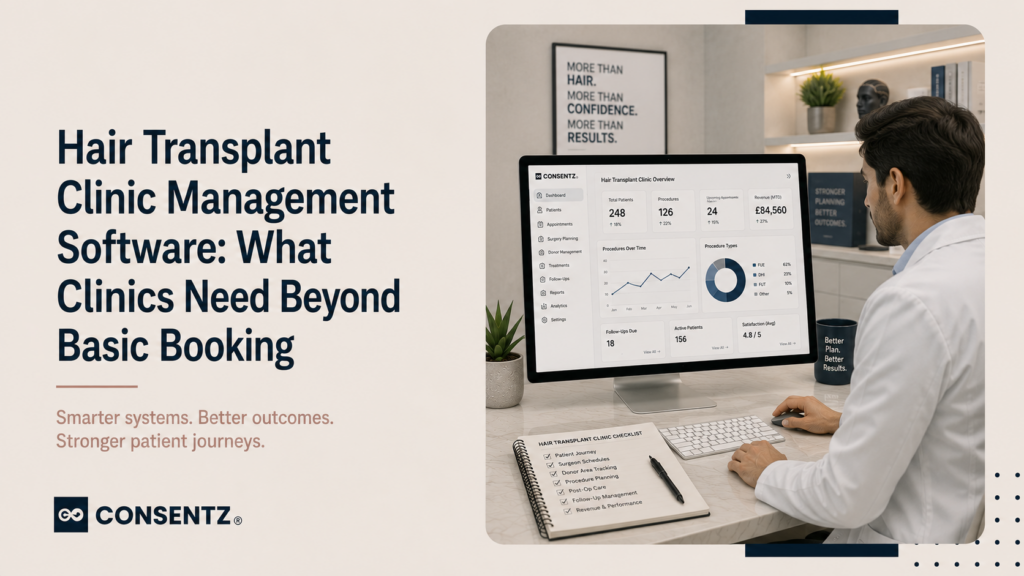
A hair transplant is not a single appointment. It is a multi-stage clinical relationship that runs from initial consultation through pre-operative assessment, the procedure itself, and follow-up reviews at one, three, six, and twelve months post-treatment. Managing that journey in a basic booking tool — or worse, across spreadsheets, WhatsApp threads, and a paper file — creates gaps that affect both compliance and patient outcomes.
Hair transplant clinics have specific software requirements that most clinic management systems were not built to handle: surgical-level consent documentation, multi-stage course management, clinical photography at fixed review intervals, and stock management for specialist products including PRP (platelet-rich plasma) solutions, graft preservation media, and surgical consumables.
The hair transplant patient journey — and where software needs to support it
The journey for a hair transplant patient typically runs through six distinct stages, each with its own documentation requirements:
- Initial consultation: medical history, hair loss assessment (Norwood scale or Ludwig scale), scalp photography, treatment options discussed, realistic outcomes communicated
- Pre-operative assessment: blood tests reviewed, medications checked for contraindications, surgical consent completed, pre-operative instructions issued
- Procedure day: surgical consent reconfirmed, graft count recorded, donor and recipient area photographed intraoperatively, anaesthetic and products used with batch numbers recorded
- Immediate post-operative (24–72 hours): aftercare instructions documented, first review scheduled
- Follow-up reviews (1, 3, 6, 12 months): photographic comparison at each interval, growth assessment, patient satisfaction recorded
- Maintenance/future procedures: many patients return for hairline refinements, scar camouflage, or further sessions 12–24 months after the initial procedure
Each of these stages generates documentation that needs to be linked to the patient record, retrievable immediately, and defensible in the event of a complaint or complication. Surgical procedures carry higher complaint rates than non-surgical aesthetics — which means the documentation standard needs to be correspondingly higher.
Bookings, consent forms, patient records, payments, marketing — Consentz is the aesthetic clinic software that puts it all in one place so you can focus on your patients, not paperwork.
Before and after photography — the most critical record for hair transplant patients
No treatment depends more heavily on clinical photography than hair transplantation. The visual record — pre-procedure, intraoperatively, and at each follow-up interval — is both the clinical measure of outcome and the legal defence if a patient claims the result did not match what was communicated.
Hair transplant clinical photography requires:
- Standardised positioning and lighting at every session — so images taken at 6 months can be accurately compared to day-one baseline photos
- Separate photo consent covering clinical storage and any marketing or educational use — these require different opt-ins
- Secure, GDPR-compliant encrypted storage with access controls — hair transplant photos are sensitive medical data
- Ghost imaging capability for precise before/after overlay comparison at review appointments
Storing these images in a personal iPhone or shared cloud folder is not compliant. They need to be linked directly to the patient record in a system that provides encryption and audit-tracked access.
Consent for hair transplant procedures
Hair transplant consent is more complex than aesthetic injectable consent. The procedure involves local anaesthesia, sedation in some cases, surgical incisions, and a realistic risk of suboptimal graft take. The consent document needs to cover all of this — and it needs to be signed well in advance of the procedure, not on the day.
The types of consent a clinical aesthetic practice needs apply here with additional layers: surgical procedure consent, anaesthesia consent (if sedation is used), and a realistic-outcomes declaration — where the patient acknowledges that the result may differ from examples shown, and that additional sessions may be required. Each of these should be a separate document, signed digitally in advance with a timestamped audit trail.
Stock management for PRP and surgical consumables
Hair transplant clinics using PRP have a specific stock management challenge: PRP is typically prepared fresh on the day of the procedure from the patient’s own blood. The centrifuge, collection tubes, and growth factor solutions all need to be tracked as consumables. Some clinics also use exosome solutions or specialist preservation media for grafts — each with batch numbers and expiry dates.
The MHRA requirement for batch-level traceability from goods received to patient administration applies to prescription medicines used in hair restoration procedures. The goods received process — logging the batch number, expiry date, and condition on arrival for every surgical consumable — is the start of that compliance chain.
Managing a multi-practitioner hair transplant team
A hair transplant procedure involves a surgical team — the lead surgeon, and typically multiple technicians handling graft preparation and placement. Managing this in a single clinic calendar without double-booking rooms, equipment, or team members requires a multi-practitioner calendar that assigns resources at the room and equipment level, not just by practitioner availability.
Role-based access matters here too: surgical technicians need access to the procedure schedule and patient prep information, but should not have access to the full medical history or financial records. The lead surgeon needs complete access to everything. Reception manages bookings without seeing clinical detail.
Follow-up automation — keeping patients engaged across a year-long journey
Hair transplant follow-up requires discipline. A patient who misses their 3-month review does not just lose one appointment — they lose clinical evidence of progress at the critical early-growth stage, which is often when expectations need careful management. Automated recall campaigns at each review interval — 1 month, 3 months, 6 months, 12 months — ensure no patient falls through without a follow-up.
The automated message at each interval can be personalised by the stage: the 1-month message reassures about normal shedding, the 3-month message explains what early regrowth looks like, the 6-month message invites a formal photographic review. This content-led approach to patient retention drives review attendance and referrals — patients who feel well-supported through a hair transplant journey become your best source of word-of-mouth referrals.
Frequently asked questions
1. What specific features does a hair transplant clinic need from software?
Multi-stage treatment course management (consultation through annual follow-up), surgical consent with a pre-procedure cooling-off period enforced, clinical photography at standardized angles linked to each stage, PRP and surgical consumable stock tracking with batch numbers, multi-practitioner team calendar with room and equipment management, and automated follow-up sequences at clinical review intervals. Most standard booking tools handle none of these.
2. How do I manage multi-stage treatment courses from consultation to 12-month follow-up?
Consentz manages treatment courses as structured protocols — you define the stages (consultation, procedure, 1-month review, 3-month, 6-month, 12-month), and the system tracks which stages are complete, which are outstanding, and automatically triggers recall messages when a review interval arrives and the patient has not rebooked. Each stage has its own documentation section, so the clinical record builds progressively rather than everything sitting in one undifferentiated notes field.
3. What pre-operative and post-operative documentation do I need?
Pre-operative: medical history form with medications and contraindications, scalp and donor area assessment, realistic outcomes communication, separate surgical consent (not the same as a standard aesthetic consent form), anaesthesia consent if applicable. Post-operative: discharge instructions with emergency contact information, aftercare protocol, and a scheduled review calendar with automated reminders at each stage. All of this should be linked to the patient record and retrievable immediately.
4. How should before and after photos be stored for hair transplant patients?
In an encrypted, GDPR-compliant clinical photography system linked directly to the patient record — not on personal devices or shared drives. Photos should be taken at standardised angles at every stage (baseline, procedure day, each review interval), with the date and stage tagged to the image. Separate written consent is required for any marketing use. Consentz stores clinical photography with ghost imaging capability for overlay comparison, linked to each appointment in the patient’s record.
5. Can I manage graft-related stock and PRP supplies in the same system as patient records?
Yes. Consentz’s stock module handles both prescription and non-prescription medical consumables — including PRP collection tubes, graft preservation solutions, and surgical disposables — with batch number tracking and expiry alerts. Stock usage is linked to the specific patient and procedure at the point of treatment, creating the traceability chain required if a product is recalled or an adverse event is investigated.