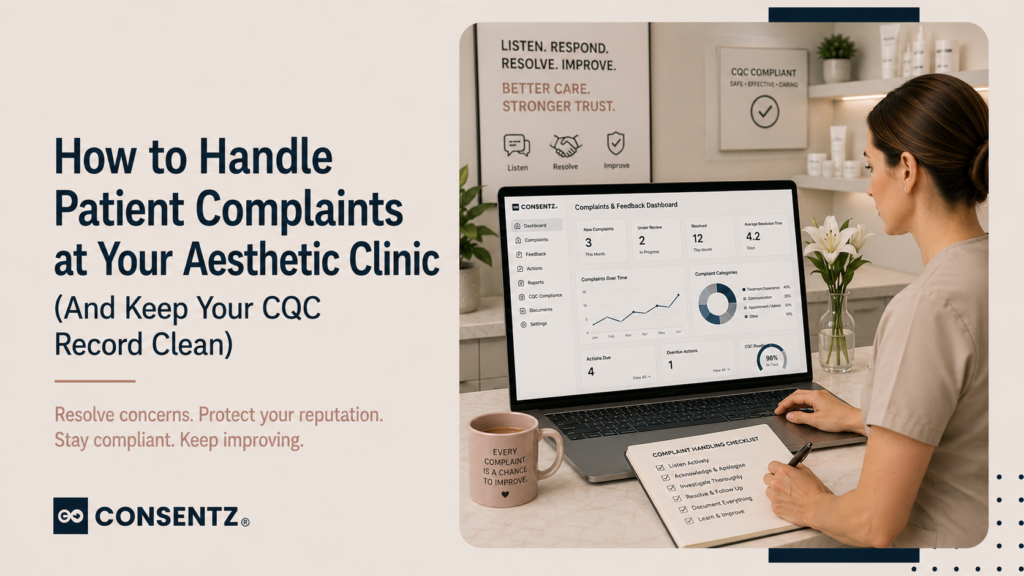
A patient complaint in an aesthetic clinic is not just an unpleasant conversation. Handled correctly, it is a documented resolution that demonstrates your clinic’s governance is working as it should. Handled incorrectly — or worse, not handled at all — it becomes a CQC inspection finding, a professional indemnity claim, and potentially a situation that affects your registration.
The good news is that most complaints in aesthetic clinics are resolvable, and a well-managed complaint process produces documentation that actually strengthens your position in any subsequent review. CQC’s Responsive domain specifically assesses how services handle concerns and complaints — and a clinic that can demonstrate a systematic, evidenced process scores better than one that has no complaints, because inspectors know the latter is statistically implausible.
The two types of complaint aesthetic clinics deal with
Most complaints in aesthetics fall into two categories, each requiring a slightly different response:
Formal complaints
A written complaint — whether by letter, email, or online form — that explicitly requests a response. Once received, this triggers your formal complaints procedure with mandatory response timescales (typically 3 working days for acknowledgement, 20 working days for a full response in NHS-aligned settings; adjust based on your own policy, but be consistent and state timescales clearly).
Informal complaints and concerns
Verbal concerns raised in clinic, a WhatsApp message expressing dissatisfaction, or a worried post-treatment call. These are not less important than formal complaints — they are often how formal complaints begin if not handled well. Every informal concern should be logged in the patient’s record alongside the response, even if it does not escalate. If it later does escalate, that documentation is your evidence of good faith.
The 5-stage complaint handling process for aesthetic clinics
Review and learn. CQC’s Well-Led domain specifically assesses whether your clinic learns from complaints. Document what the complaint taught you — whether it changes a protocol, a consent form, a communication approach, or nothing at all. A review record showing ‘no protocol change required — investigation found treatment was within accepted parameters’ is positive evidence, not a gap.
Acknowledge promptly and without defensiveness. Acknowledge every complaint within 3 working days. A simple acknowledgement — confirming receipt, naming the person handling it, and stating when the patient can expect a full response — is not an admission of fault. Not responding or being slow to respond consistently escalates complaints that could have been resolved informally.
Investigate thoroughly. Review the patient’s complete record — consultation notes, consent forms, before and after photographs, treatment notes, and any communication history. If the complaint involves a prescription product, the prescribing record and batch number should also be reviewed. The investigation is not about finding fault — it is about understanding exactly what happened from all available evidence.
Respond formally and factually. Your response should: acknowledge the patient’s experience, explain what you found during the investigation, explain what happened and why (if the investigation supports a clear explanation), state what you will do differently if there is an improvement to make, and apologise for distress without necessarily admitting clinical fault (an apology is not an admission of liability). Have your clinical indemnity insurer involved if the complaint has a claims dimension.
Record everything. The complaint, every piece of correspondence, the investigation findings, and the resolution should all be linked to the patient’s file. This is the evidence pack you produce for a CQC inspection or a professional indemnity claim. Complaints recorded in a separate folder from the patient record are harder to retrieve, easier to lose, and make cross-referencing with clinical notes during an inspection unnecessarily complicated.
Bookings, consent forms, patient records, payments, marketing — Consentz is the aesthetic clinic software that puts it all in one place so you can focus on your patients, not paperwork.
What CQC inspectors look for in complaints handling
Complaints are assessed under two CQC inspection domains: Responsive (whether people can raise concerns and have them addressed) and Well-Led (whether the organisation learns from complaints and uses them to improve). Both domains carry weight in the overall inspection rating.
What inspectors want to see:
- A written complaints policy that is accessible to patients
- Evidence that complaints are acknowledged within the stated timescale
- Investigation records for every formal complaint
- Evidence of learning — what changed (if anything) as a result
- A complaints log showing volume, themes, and resolution outcomes over time
What fails inspections:
- No complaints policy or a policy that exists on paper but is not followed
- Complaints mentioned verbally but with no written record
- An implausibly low number of logged complaints (suggests under-reporting rather than genuine absence)
- No evidence that any complaint resulted in a review, even when a review would have been appropriate
For the full picture of what CQC inspectors assess — including complaints — the CQC compliance documentation toolkit covers all five domains. For what happens when a clinic falls short in any of them, what happens if you fail a CQC inspection covers the full enforcement process.
Negative online reviews — a separate but related process
A negative Google or Instagram review is not a formal complaint, but it is not something to ignore either. The way you respond publicly to a negative review matters because potential patients read your response as a signal of how you handle things when they go wrong.
The approach that works:
- Respond within 48 hours: acknowledges promptly without rushing to defend
- Do not discuss clinical details publicly: GDPR and patient confidentiality prohibit responding to clinical specifics in a public forum, even if the reviewer has shared their own details
- Invite the reviewer to contact you directly: ‘We would really like to discuss this with you — please contact us at [email]’ is the correct public response, regardless of whether you believe the review is fair
- Log it internally: a negative review that raises a clinical concern should be treated as an informal complaint and logged accordingly
One thing to avoid: responding defensively, disputing the reviewer’s account publicly, or providing clinical justification. Even if the response is factually correct, it reads badly to prospective patients and potentially breaches patient confidentiality.
How Consentz supports complaint documentation
Consentz allows you to create a complaint record directly linked to a patient’s file — so the consent form, treatment notes, before and after photographs, correspondence, investigation findings, and resolution are all in the same place and retrievable in one step.
When a CQC inspection arrives and asks to see your complaints process, you are not searching through separate folders or reconstructing timelines from email chains — everything is in the patient record where it should be.
Frequently asked questions
1. What is the correct process for handling a patient complaint at an aesthetic clinic? clinic?
Acknowledge within 3 working days, investigate using the full patient record (including consent forms, notes, photographs, and prescribing records where relevant), respond formally within 20 working days with a clear explanation and any appropriate apology, log the complaint and resolution in the patient file, and document whether any protocol change is required as a result. The same process applies whether the complaint was received by email, letter, or verbal communication — all complaints should be handled consistently regardless of channel.
2. Does CQC inspect how aesthetic clinics deal with complaints?
Yes, under both the Responsive and Well-Led inspection domains. CQC inspectors ask to see your complaints policy, the complaints log, and evidence that complaints are investigated and learned from. An absence of complaints in your log is more likely to raise questions than a modest number of well-handled ones — inspectors know that any active clinical service generates concerns, and a clean log more often signals under-recording than genuine absence.
3. How do I document a complaint in a way that protects me legally?
Document contemporaneously — at the time of each stage, not reconstructed later. Record: date complaint received, how it was received, who it was assigned to, when the acknowledgement was sent, what the investigation found (with reference to the specific records reviewed), what the response said, and whether any protocol change resulted. This contemporaneous record is your evidence in any subsequent professional indemnity or medico-legal context.
4. What should I do if a patient leaves a negative review online after a complication?
Respond publicly within 48 hours, briefly and without clinical detail. Acknowledge the patient’s experience, express that you take all feedback seriously, and invite them to contact you directly. Do not dispute the review publicly or share any clinical information. Internally, treat the review as an informal complaint and log it — if it raises a clinical concern (such as a potential complication), investigate it using the same process as a formal complaint and document the outcome accordingly.
5. How quickly do I have to respond to a formal complaint?
Your complaints policy should specify response timescales, and you must follow them consistently. NHS guidance (used as a benchmark by CQC for private clinics) expects acknowledgement within 3 working days and a full response within 20 working days. If you need more time for a complex investigation, communicate the extended timescale to the patient with an explanation. Missing your own stated timescales without communication is a compliance finding in itself.