Patient experience in aesthetics is not a single moment — it is the sum of every touchpoint from the first message to the treatment review six months later. The clinics that build lasting reputations are not always the ones with the best injectors. They are the ones where the experience around the treatment is as good as the treatment itself.
A 5-star patient journey does not happen by accident. It is a series of deliberate decisions about what happens at each stage of the patient relationship, combined with the systems that make those decisions consistent — for every patient, every time, regardless of how busy the clinic is.
This guide walks through all seven stages of the patient journey and what excellence looks like at each one.
Stage 1: Enquiry — responding fast enough to matter
The first moment that shapes patient experience is the response to an initial enquiry. Research across service businesses shows that responding within five minutes makes conversion up to 21 times more likely than responding after an hour. In a clinic where the practitioner is treating patients and cannot monitor DMs in real time, an automated first response — acknowledging the enquiry, confirming the information they asked about, and providing a clear path to booking — holds the conversation until a personal follow-up is possible.
The patient pipeline is where this stage lives: every enquiry logged, tracked, and followed up systematically. An enquiry that disappears into a DM thread or an unread email is revenue lost before the patient ever books.
Stage 2: Booking — making it easy and commitment-creating
The booking experience signals a lot about the clinic before the patient arrives. A clunky booking process, a callback that never comes, or a deposit that needs to be paid via a separate link sent later all create friction that plants doubt.
Online booking that patients can complete at 10pm, that collects a deposit automatically, and that confirms the appointment instantly feels premium because it removes friction. The deposit is not just a no-show deterrent — it is a commitment signal. A patient who has paid feels different about the appointment than one who has merely said yes over the phone.
Stage 3: Pre-appointment — reducing anxiety and building trust
The period between booking and attending is when patients most often talk themselves out of attending, or start comparing your clinic with others. What happens in this gap determines whether they arrive confident or cautious.
The pre-appointment sequence that builds trust:
- Consent form sent immediately after booking: digital consent forms sent at the point of booking serve the cooling-off requirement and give the patient information to read at their own pace — before any appointment pressure.
- Preparation instructions: what to avoid before the treatment (alcohol, aspirin, makeup for injectables), what to wear, where to park. Sent by email 48–72 hours before the appointment.
- Appointment reminder: SMS and email reminders 48 and 24 hours before the appointment, with the clinic address and a clear cancel/rebook link.
A patient who arrives having received all of this feels expected, prepared, and valued — before the consultation has even started.
Bookings, consent forms, patient records, payments, marketing — Consentz is the aesthetic clinic software that puts it all in one place so you can focus on your patients, not paperwork.
Stage 4: In clinic — the experience that drives word of mouth
The in-clinic experience is where the practitioner’s work speaks. But the non-clinical elements matter more than most practitioners think: the waiting area, how the consultation is structured, whether the practitioner reviews the completed consent form with the patient before proceeding, and how the treatment outcome is communicated at checkout.
The consultation
The consultation is where expectations are set. Patients who leave with realistic expectations of what the treatment will deliver — and who feel genuinely heard during the assessment — are the patients who rebook, refer, and review. Patients who feel rushed or who were promised a result that did not materialise become complaints.
The types of consent needed — treatment, photo, marketing — should all be reviewed with the patient during the consultation, not handed over as paperwork to sign. Making the consent review a conversation, not a formality, reinforces trust and demonstrates clinical competence.
Clinical photography
Before and after photographs taken at a standardised angle and lighting serve both clinical and commercial purposes — but only when they are stored correctly and when photo consent is properly separated from treatment consent. Taking photos without explaining what they will be used for, or storing them on a personal device, creates both a GDPR risk and an erosion of patient trust if they ever find out.
Checkout and rebooking
The checkout moment is the highest-conversion point in the patient journey for the next appointment. A practitioner who recommends the next treatment timing during the consultation, and a front desk who books it before the patient leaves, consistently achieve rebooking rates of 65–75%. A vague ‘let us know when you want to come back’ produces rebooking rates below 40%.
Stage 5: Post-treatment — aftercare that feels personal
What happens in the 48 hours after a treatment determines whether the patient feels supported or forgotten. An automated post-treatment message — sent the same evening or the morning after — acknowledging that they have just had their treatment and providing specific aftercare instructions does two things: it continues the experience beyond the clinic walls, and it gives the patient a channel to reach out if they have a concern.
Aftercare instructions sent as a printed leaflet get lost. Sent digitally by email, they are searchable, shareable, and available at 11pm when a patient is worried about a bruise. The difference in the patient’s perception of being looked after is significant.
Stage 6: Review request — the moment that builds your reputation
The optimal time to ask for a review is 24–72 hours after a positive treatment outcome — when the patient is feeling good about the result and the experience is fresh. An automated review request SMS with a direct link to your Google profile, sent automatically by Consentz at a configured interval after the appointment, converts at significantly higher rates than in-clinic asks or delayed email campaigns.
Review volume is the single strongest local SEO signal for an aesthetic clinic. Every review request automation running on every appointment compounds into a growing review count that improves your Google ranking for every ‘aesthetic clinic near me’ search in your area.
Stage 7: Recall — making the patient feel remembered
The final stage of one patient journey is the trigger for the next. A recall message at the right treatment interval — not a generic promotional email, but a message that references the patient’s specific treatment and the expected timing — feels personal and thoughtful. ‘It has been 10 weeks since your Botox appointment — most patients find this is around when they start to notice their results fading’ is a very different message from ‘Book now for 15% off this month’.
Automated recall sequences filtered by treatment type and last visit date run continuously without staff involvement. Patients who receive a timely, relevant recall message rebook at 70–80%. Patients who hear nothing rebook at a fraction of that rate — and eventually stop coming back. The patient retention data consistently shows that most lapsed patients did not leave because of a bad experience — they left because nobody reached out.
Frequently asked questions
1. What are the stages of a patient journey at an aesthetic clinic?
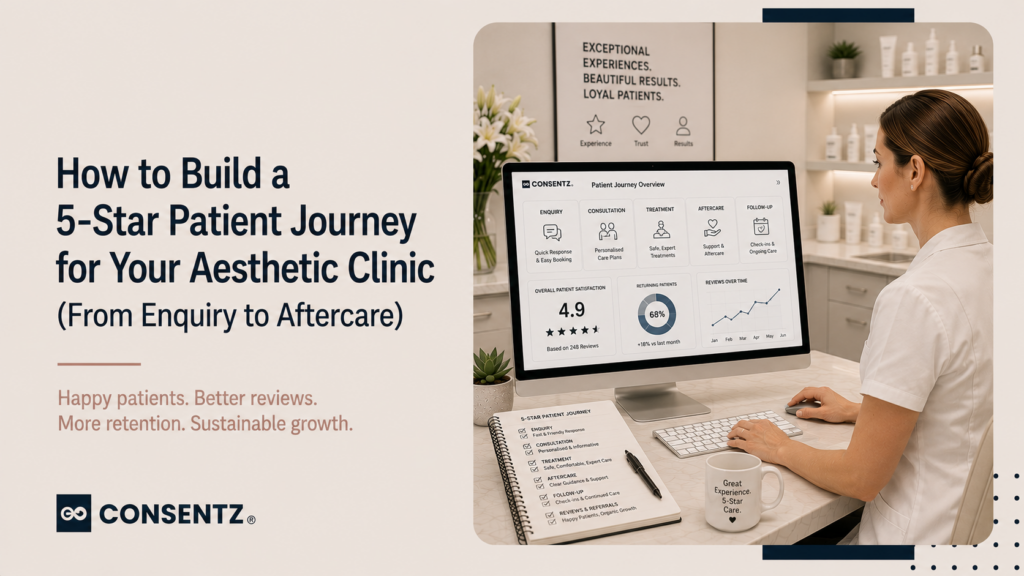
Enquiry → booking → pre-appointment preparation → in-clinic consultation and treatment → post-treatment aftercare → review request → recall and rebooking. Each stage has specific touchpoints that either build or erode patient trust. The clinics with the highest retention rates typically have all seven stages systematically managed — not just the treatment itself.
2. How do I make the booking experience feel more premium?
The single biggest improvement is removing friction: online booking that works on mobile at any time, deposit collection at the point of booking (not as a follow-up step), and an instant confirmation that confirms all the appointment details. A patient who books in 90 seconds without needing to call, wait for a callback, or receive a separate deposit link has already had a better experience than most clinics provide. The premium feeling comes from ease and clarity, not from complexity.
3. What should happen between booking and the actual appointment?
Three things: the consent form should be sent and returned (satisfying the cooling-off period and reducing chair time), preparation instructions should be sent 48–72 hours before the appointment, and appointment reminders should fire 48 and 24 hours before. A patient who arrives having received all three feels expected, prepared, and cared for before you have even greeted them at the door.
4. How do I follow up after treatment in a way that does not feel pushy?
Make the follow-up about the patient rather than the booking. ‘How is your skin feeling after your treatment?’ or ‘Here are a few things to be aware of in the next 48 hours’ is a follow-up that serves the patient. ‘Book your next appointment’ on the same day as treatment is a follow-up that serves the clinic. The recall message timed to the treatment interval — not sent immediately — converts better and builds more trust than an immediate rebooking push.
5. How do other clinics get patients to leave reviews naturally?
They automate the ask and make it effortless. A single SMS sent 24–48 hours after the appointment with a direct link to the Google review page converts far better than asking in the clinic, adding a sign in the waiting room, or sending a general newsletter asking for reviews. The key variables are timing (when the patient is still in a positive post-treatment mindset), channel (SMS, not email, for the primary ask), and friction (one tap to reach the review page, not a search and login process).